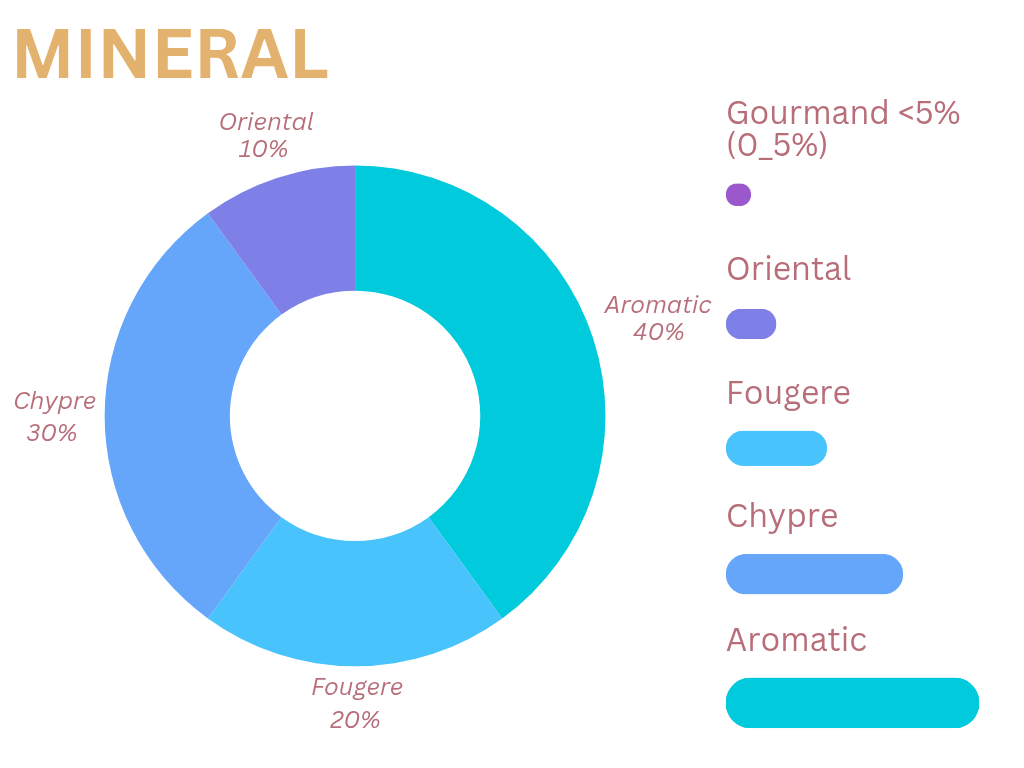

The soul that emerges from the harmony of different ingredients is the essence of the fragrance family. A family is not something tangible that can be grasped—it is an abstract entity, felt but unseen—unlike the ingredients that form the body and texture of the perfume.
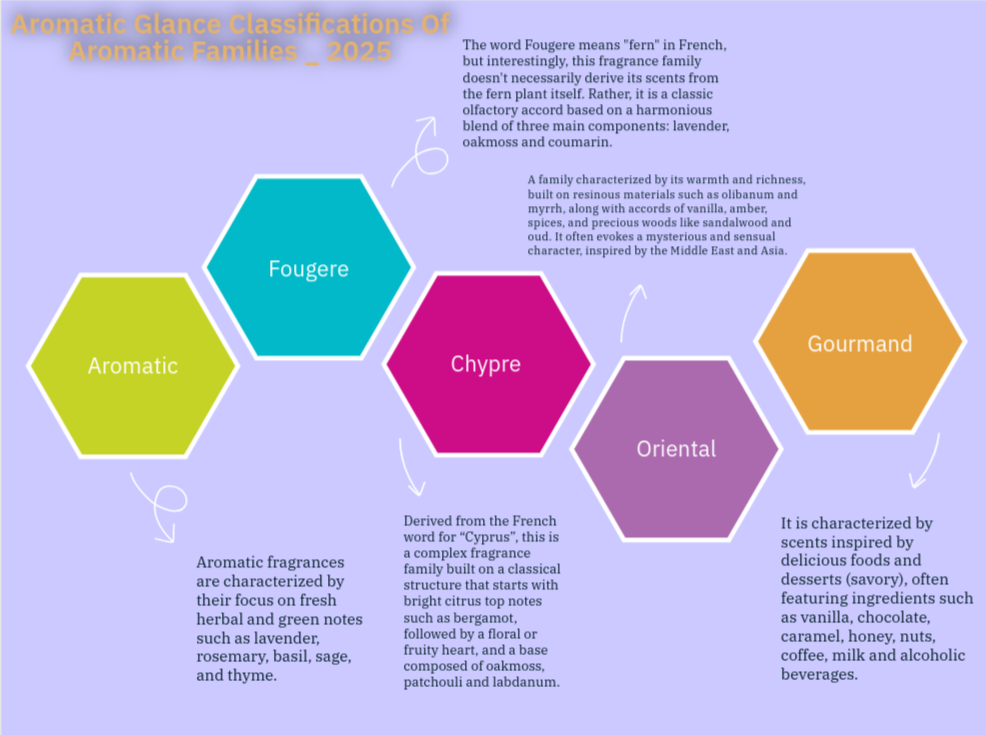
Based on this concept, Aromatic Glance classifies five principal fragrance families that represent the “soul of the perfume”:
1. Aromatic
2. Fougere
3. Chypre
4. Oriental and
5. Gourmand
These core families define the overall framework of the olfactory experience and provide each fragrance with its deep identity.
The tangible body of the perfume, on the other hand, is shaped by the sub-families—concrete elements that express the sensory presence of the fragrance and translate that invisible soul into a real, perceptible experience. We recognize ten sub-families, each playing a distinct role within the structure of the main family it belongs to in varying proportions. These are:
1. Herbal
2. Green
3. Citrusy
4. Aldehydic
5. Floral
6. Fruity
7. Spicy
8. Resinous
9. Woody
10. Leathery
11. Animalic
Each of these sub-families represents a vital component in constructing a fragrance’s identity, functioning as the “organs” that give the soul of the main family a living, breathing body rich in personality and uniqueness.
When developing our classification of primary and secondary fragrance families, we considered the primary families as representing the soul or essence of a perfume, while the secondary families are the sensory components and functional elements used to construct it.
For example, many classifications list flowers as a primary family. However, in our framework, we consider floral notes as part of the secondary families—this does not diminish their importance. Just as organs cannot function without a soul, a fragrance cannot exist without the tangible materials that make it.
From a physical and chemical perspective, secondary families refer to actual aromatic materials with measurable properties such as molecular weight, boiling point, evaporation rate, and chemical stability. These properties determine their placement within the fragrance pyramid—whether they appear in the top notes, form the heart, or anchor the base.
On the other hand, primary families are abstract concepts derived from the interplay of these materials. They are the result of how physical and chemical properties interact, rather than ingredients that exist independently during formulation. When we describe a perfume as “Oriental” or “Chypre,” we are not referring to a single identifiable material, but rather to a sensory impression formed by blending various elements from the secondary families to create a coherent essence—the primary family. Just as a human personality is shaped by a single spirit manifesting through diverse behaviors and organs, a perfume is built upon a fundamental essence (the primary family) expressed through a precisely balanced assembly of real materials (the secondary families).
These sub-families build up the olfactive architecture of the five main families. The five main families are olfactive styles, not molecular families; they are based on a blend of components, not a single material.
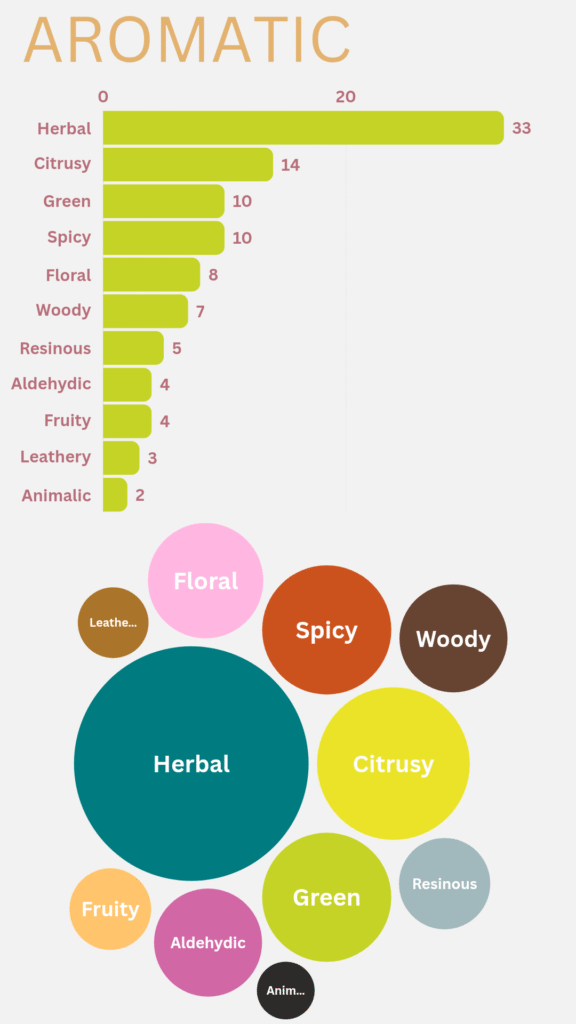
1_Aromatic:
Aromatic fragrances are characterized by their focus on fresh herbal and green notes such as lavender, rosemary, basil, sage, mint and thyme.
It also includes fruity, citrusy, woody scents and other components.
Key notes often include:
Herbs
Aquatic notes
Citrus
Green notes، with moderate appearances of:
Spices
Powdery notes
Aldehydes
Fruits
Characteristics:
Green, clean and pure character. It is generally characterized by refreshing, herbal, fruity, cool and summery scents, with zesty citrus bites, along with powdery woody notes.
. Commonly found in men’s fragrances.
. Often overlaps with other families, especially Fougere.
What makes the Aromatic family a primary fragrance category is the electric spark of citrus, the freshness of fruits, the warmth of spices, and the medicinal edge of herbs—it is also that cleanliness reminiscent of a soap bubble.
Examples:
Eau Sauvage Dior 1966, Edmond Roudnitska, Citrusy Aromatic.
Cool Water Davidoff 1988, Pierre Bourdon, Aquatic Aromatic.
French Lover Frederic Malle 2007, Pierre Bourdon, Woody Aromatic.
Terre d’Hermès Hermès 2006, Jean-Claude Ellena, Spicy Aromatic
Bleu de Chanel Chanel 2010, Jacques Polge, Woody Aromatic.
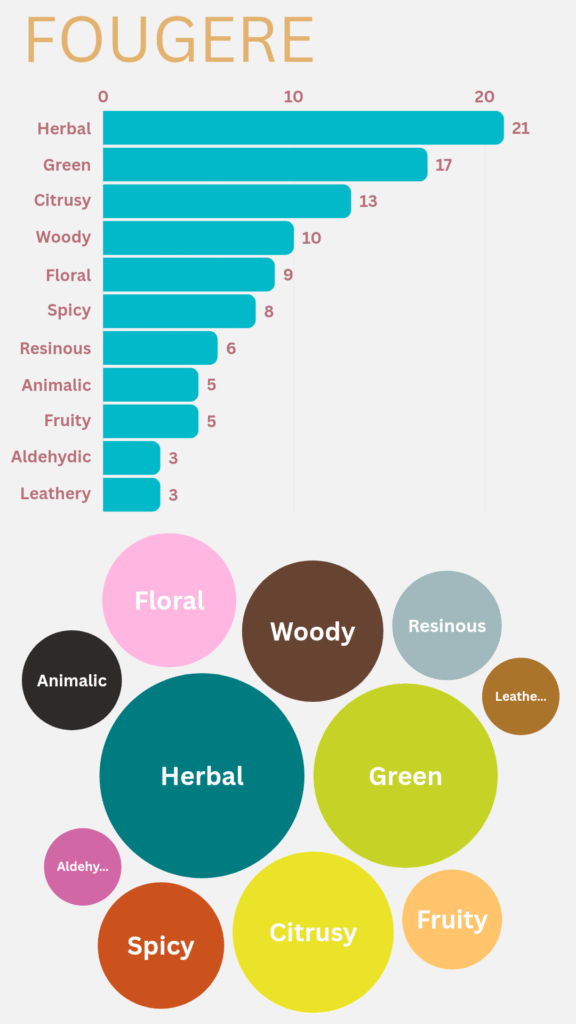
2_Fougere:
The word Fougère means “fern” in French, but interestingly, this fragrance family doesn’t necessarily derive its scents from the fern plant itself. Instead, it is a classic olfactory accord built on a harmonious blend of three main components: lavender, oakmoss and coumarin.
It typically opens with fresh citrusy notes such as bergamot, followed by an aromatic herbal heart like lavender and geranium, and ends with a warm base composed of coumarin, oakmoss and woody elements like vetiver.
Fougere fragrances are characterized by a balance of earthy freshness and light herbal sweetness.
The Fougere family is a classical olfactory accord that mainly relies on the combination of lavender, oakmoss and coumarin, resulting in a fragrance with an elegant, fresh and masculine character.
Characteristics:
It is characterized by clear notes of:
Citrus
Green
Woody
Fresh spicy
And sometimes clean earthy notes.
. A contrast between freshness and warmth.
. Masculine in nature, fresh and elegant, but has started appearing in modern feminine perfumes.
blends the Aromatic and Chypre families sometimes.
Examples:
Fougere Royale Houbigant 1882, Paul Parquet, Aromatic Fougere, first fougere fragrance.
Jicky Guerlain 1889, Aime Guerlain, Oriental Fougere.
Eros Versace 2012, Aurelien Guichard, Aromatic Fougere.
Right after the Aromatic family comes Fougere, as the two represent a natural and classic harmony.
Fougere fragrances are fundamentally built around an aromatic heart, such as lavender and rosemary, which makes the overlap between them common and well-balanced.
The Aromatic facet gives Fougere a herbal freshness that enhances its classic structure.
Examples:
Drakkar Noir Guy Laroche 1982, Pierre Wargnye, Aromatic Fougere.
Azzaro pour Homme 1978, Gerard Anthony and Richard Wirtz, Aromatic Fougere.
Fahrenheit Dior 1988, Jean-Louis Sieuzac, Michel Almairac and Maurice Roger, Aromatic Fougere.
The relationship between the Fougere and Oriental families is based on the harmony between fresh, herbaceous structure and sensual warmth.
Fougere brings aromatic freshness and cleanliness to the Oriental framework, while the Oriental side adds warmth and depth to the Fougere, resulting in more alluring and bold compositions.
Sculpture Homme Nikos 1995, Michel Almairac, Oriental Fougere.
Le Male Jean Paul Gaultier 1995, Francis Kurkdjian, Oriental Fougere.
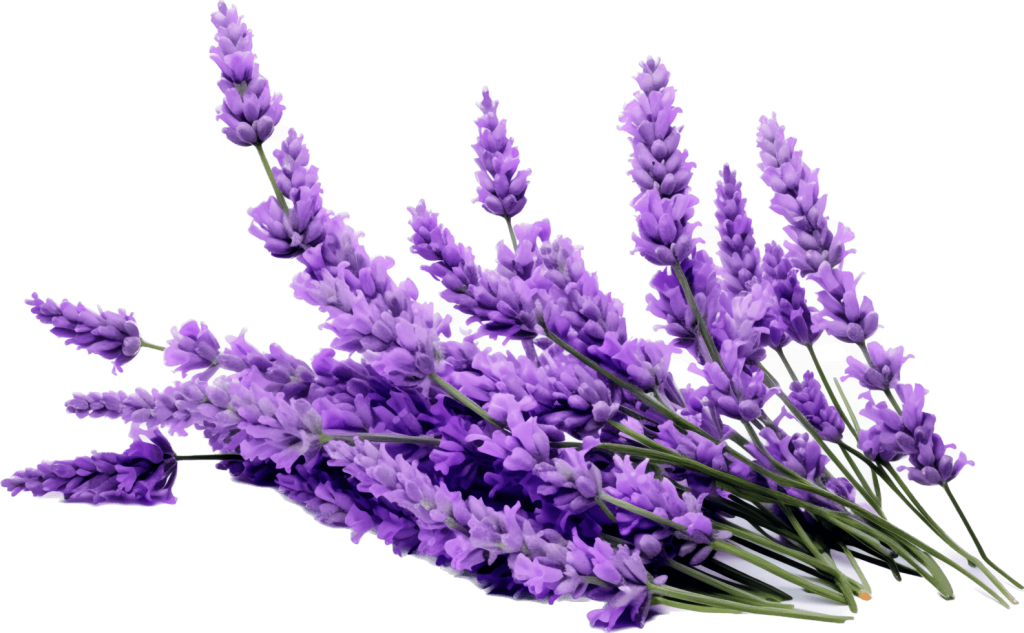
Lavender
🌿 Botanical Source:
Lavandula angustifolia – An aromatic plant from the Lamiaceae family, native to the Mediterranean region, particularly southern France (Provence), Italy, and Spain. It is widely cultivated for the extraction of lavender essential oil through steam distillation from the dried purple flowers. It is one of the oldest materials used in perfumery and body care.
🏷️ Aromatic Family Classification:
Aromatic Fougere
📐 Olfactory Architecture:
Aromatic: 45%
Fougere: 40%
Chypre: 5%
Oriental: 5%
Gourmand: 5%
👃 Olfactory Scent:
Lavender is characterized by an aromatic, floral-herbaceous scent that is clean, bright, and balanced between aromatic coolness and floral warmth:
Herbaceous floral aromatic
Clean and refreshing
A subtle camphoraceous nuance
Dry powdery undertone
A balance between freshness and warmth
A sense of serenity and inner purity
“Fresh, floral-herbaceous scent with a balsamic woody undertone and a subtle camphoraceous top note” – IFF Monograph
“Smooth, suave, coumarin-rich, intense, sweet herbal-lavender aroma that resembles the fresh botanical material.” – Eden Botanicals
🧬 The Most Prominent Active Molecules in Lavender Oil:
Linalool
Scent: Floral – Herbaceous – Powdery
Role: Adds floral softness and a calming, neuro-soothing effect.
Linalyl Acetate
Scent: Soft fruity – Floral – Powdery
Role: Enhances luxurious softness and reinforces the elegant and soothing character of lavender.
1,8-Cineole (Eucalyptol)
Scent: Camphoraceous – Clean – Refreshing
Role: Contributes a bright, camphoraceous top note and a sense of freshness.
Camphor (in low percentage)
Scent: Camphoraceous – Cool – Herbal
Role: Adds a natural medicinal nuance, especially found in other lavender species like Lavandula latifolia.
⚙️ Structural Role in Perfume Design:
Heart Note – Lavender is commonly used in the heart or top of a fragrance to provide:
A clean and pure aromatic character
Balance between floral and herbal aspects
A soothing and calming effect
A soft powdery base
A delicate green-camphoraceous nuance
Prominently used in:
Classic and modern fougère fragrances
Masculine aromatic compositions
Clean floral perfumes
Sleep and relaxation scents
🎶 Olfactory Harmony:
Lavender blends beautifully with:
Citrus (Bergamot, Lemon, Grapefruit): To bring bright freshness to the top note.
Rose, Iris, Neroli: For a soft and balanced floral dimension.
Oakmoss, Coumarin, Tonka Bean: To construct a powdery-woody fougère heart.
Sandalwood, Cedarwood, Vetiver: For a clean-textured woody base.
Amber, Musk, Benzoin: To create a warm, comforting, long-lasting base.
Spices (Clove, Nutmeg): To add subtle oriental depth and complexity.
Herbs (Thyme, Rosemary, Sage): To enhance the natural, pure aromatic profile.
🧪 Synthetic Analogs / Imitative Molecules:
Due to the variability in quality and high cost of natural lavender oil—as well as the prevalence of adulterated or diluted versions—many synthetic molecules are used to replicate or enhance its scent with more control over purity and stability:
Linalool (Synthetic):
Widely used to mimic the floral-herbaceous side of lavender, offering higher purity and stability than natural.
Linalyl Acetate (Synthetic):
One of the key molecules used to simulate the soft fruity-floral character of lavender; frequently found in fougère and clean perfumes.
Lavandulol & Lavandulyl Acetate:
Synthetic derivatives that boost the soft floral-herbaceous impression, often used as supporting or partial replacement ingredients.
Isoraldeine 70:
A synthetic molecule with a clean floral tone resembling the heart of lavender, widely used in fougère formulas.
Herboxide:
A synthetic alternative with a fresh green-herbaceous touch, reminiscent of the fresh facets of lavender oil.
Vertofix Coeur:
Sometimes combined with lavender to create a soft woody-ambery base that supports the composition’s longevity and roundness.
📌 Final Notes:
What distinguishes lavender’s key molecules is their medium to high polarity, giving them excellent diffusion and a strong clean first impression—though at the cost of lower longevity compared to non-polar base notes like sandalwood.
The main natural components, such as linalool and linalyl acetate, belong to the monoterpenes and their esters, and are among the most researched and widely used materials in perfumery, known for their calming, antibacterial, and refreshing properties.
Adjusting the ratios of synthetic lavender molecules allows for unlimited creative variations in perfumery: – From a classic masculine barbershop profile
– To a soft floral-powdery feel in feminine fragrances
– Or even as a refined clean-soapy background in niche perfumes.
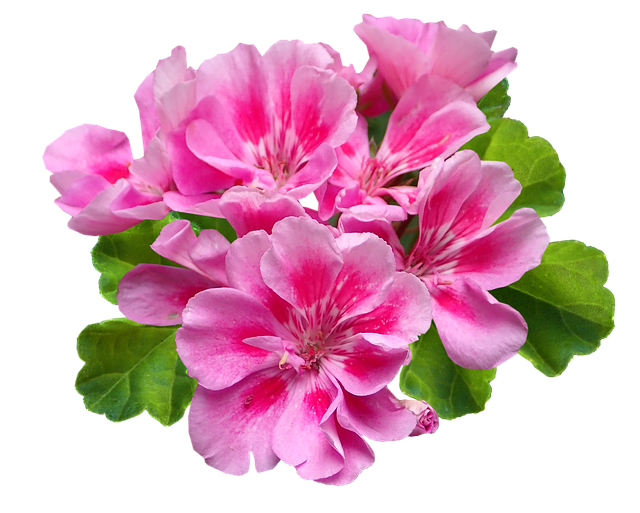
Geranium
🌿 Botanical Source:
Pelargonium graveolens – A perennial aromatic herb from the Geraniaceae family. Native to South Africa, it is now widely cultivated in Egypt (Baladi type), Madagascar, China, and Morocco.
Geranium essential oil is extracted from the leaves and stems of the plant via steam distillation. It is widely used in perfumery, skincare, and soaps.
🏷️ Aromatic Family Classification:
Aromatic Fougere
📐 Olfactory Architecture:
Aromatic: 30%
Fougere: 35%
Chypre: 15%
Oriental: 15%
Gourmand: 5%
👃 Olfactory Scent:
Geranium oil features a fresh, floral-green-herbaceous scent that is multifaceted and vibrant:
Fresh green-floral scent
Rosy nuance with a stronger, more herbaceous character
Touches of mint or menthol-like freshness
Soft floral sweetness
Lush, clean impression
Strong aromatic presence
“A fresh, rosy-sweet, minty, and herbaceous green scent, often used as a more affordable rosy nuance in perfumery.” – IFF
“Very fresh, light rose-like floral, with pronounced, leafy green/herbaceous body notes.” – Eden Botanicals
🧬 The Most Prominent Active Molecules in Geranium Oil:
Citronellol
Scent: Rosy – Fruity – Soft
Role: Gives the oil a warm rosy character and adds sweetness and freshness.
Geraniol
Scent: Floral – Herbaceous – Fresh
Role: Enhances the floral-herbal facet and adds a bright, feminine glow.
Linalool
Scent: Powdery – Floral – Herbaceous
Role: Adds smoothness and harmony between herbal and floral notes.
Isomenthone
Scent: Mentholic – Cool – Green
Role: Contributes a green-mentholic freshness to the overall profile.
Citronellyl Formate
Scent: Fruity – Floral – Soft
Role: Provides a light, fruity nuance that balances the overall aroma.
⚙️ Structural Role:
Heart Note – Geranium oil is primarily used as a mid-note to deliver:
A vivid green-floral character
A cost-effective floral substitute for rose
A clean and concentrated aromatic accent
Vitality and freshness in the heart of the fragrance
Balance between floral, herbal, and citrus elements
Commonly used in:
Classic masculine fougère compositions
Crisp green floral perfumes
Aromatic and fresh fragrance constructions
Rosy scents with sharp or herbal edges
Body mists and fragrant soaps
🎶 Olfactory Harmony:
Geranium blends harmoniously with:
Rose, Lavender, Neroli: To amplify the floral dimension and create a refreshing bouquet.
Bergamot, Lemon, Grapefruit: For a bright citrusy opening.
Oakmoss, Vetiver, Patchouli: To form a strong fougère or chypre heart.
Clary Sage, Rosemary, Basil: To enhance the herbaceous-aromatic backbone.
Cedarwood, Sandalwood: For a clean and woody base.
Musk, Amber: To soften the green facets and add warmth.
Mint, Eucalyptus: To emphasize the mentholic-fresh nuance.
🧪 Synthetic Analogs:
To stabilize the note or replicate it when natural geranium oil is limited or for enhanced longevity, synthetic molecules are commonly used:
Geraniol (synthetic): Mimics the clean floral–herbal aspect.
Citronellol (synthetic): Provides lasting power and reinforces the soft rosy tone.
Rhodinol: A synthetic blend that gives a concentrated rosy-geranium effect.
Verdox: Adds a fruity–green–fresh note to the top.
Leaf Acetate (cis-3-Hexenyl acetate): Offers a crisp leafy-green nuance reminiscent of fresh geranium leaves.
📌 Final Notes:
What distinguishes geranium is its richness in monoterpenes and floral alcohols, making it a perfect balance between green strength and floral sweetness, with excellent diffusion and blending properties.
Often used as a rose substitute, geranium has its own identity: more herbal, more refreshing, and sometimes more assertive. It serves as a perfect aromatic bridge between floral and herbal aspects—especially in classic fougère and chypre compositions.
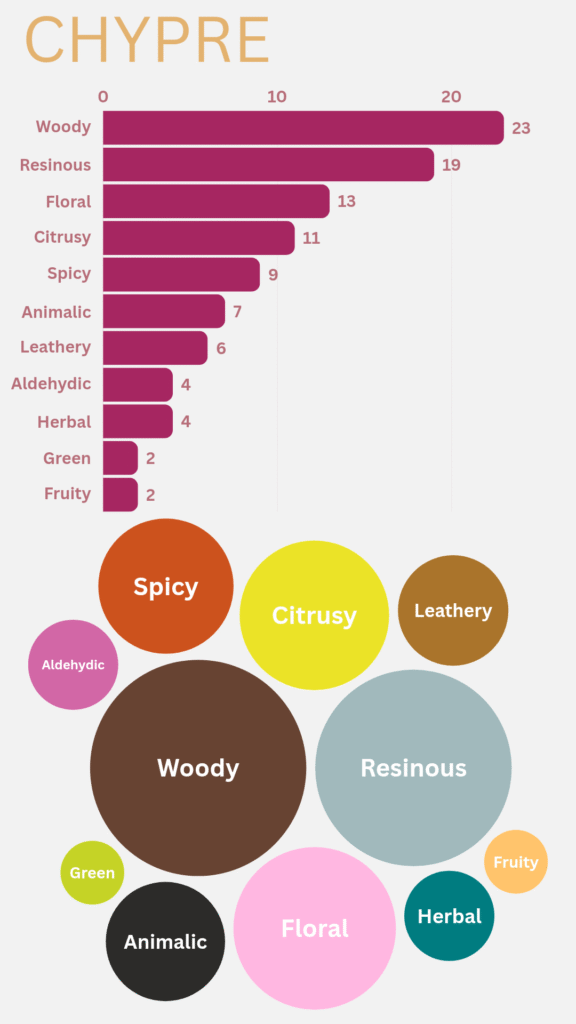
3_Chypre:
Derived from the French word for “Cyprus”, this is an Elegant and sophisticated classicism fragrance family built on a classical structure that starts with bright citrus top notes such as bergamot, followed by a floral or fruity heart, and a base composed of oakmoss, patchouli and labdanum.
The first Chypre fragrance was Chypre Coty, released in 1917 by perfumer Francois Coty.
Characteristics:
. Mysterious, dry, and elegant aura.
. Classic and well-balanced.
. Displays a contrast between softness and austerity.
Examples:
Mitsouko Guerlain 1919, Jacques Guerlain, Fruity Chypre.
Miss Dior 1947, Jean Carles and Paul Vacher, Floral Chypre.
Antaeus Chanel 1981, Jacques Polge, Woody Chypre.
Coco Mademoiselle Chanel 2001, Jacques Polge, Floral Chypre.
Creed Aventus 2010, Jean-Christophe Herault and Erwin Creed, Fruity Chypre.
Chypre Palatin MDCI Parfums 2012, Bertrand Duchaufour, Fruity Chypre.
Chypre follows Fougere directly in the classification, forming a deep and captivating accord.
Both families share the use of bergamot and oakmoss, but Chypre is drier and more elegant, while Fougere is fresher and more herbal.
Blending the two creates a balance between freshness and austerity.
Aromatic and Chypre create an elegant and natural harmony together.
Aromatic notes can add a green, clean touch to the Chypre structure, softening its dryness and making it more refreshing and versatile.
🌿 Botanical Source:
Evernia prunastri – A type of lichen that grows on the bark of oak trees in moist, shaded climates, especially in Central Europe and the Balkans.
The moss is carefully harvested, dried, and processed to extract an aromatic concrete, which is then converted into essential oil or absolute via solvent extraction.
🏷️ Aromatic Family Classification:
Woody Chypre
📐 Olfactory Architecture:
Aromatic: 10%
Fougere: 20%
Chypre: 50%
Oriental: 20%
Gourmand: 5%>
👃 Olfactory Scent:
Oakmoss is known for its deep, earthy, damp, and subtly leathery scent:
Earthy – Forest-like – Dark green
Soft balsamic
Dry leathery nuances
Moist bark-like freshness
Subtle animalic trace
Mysterious and meditative undertone
> “Oakmoss is what makes a Chypre a Chypre. It’s shadow, breath, and the memory of ancient forests.” — Luca Turin
Dry, earthy, bark and pine-like top notes over smooth, rich notes of moss, wood, decaying leaf, fungus, lichen, and damp earth; deep, mysterious, evocative, and an excellent fixative with tremendous tenacity. — Eden Botanicals
🧬 The Most Prominent Active Molecules in Oakmoss:
Atranol & Chloroatranol
Scent: Earthy – Mossy – Balsamic
Role: Provide the wet mossy signature and are fundamental to classical chypre structures (now restricted under IFRA regulations).
Evernic Acid
Scent: Woody – Green – Resinous
Role: Adds a light resinous touch and supports fragrance longevity.
Lichenol
Scent: Earthy – Herbal – Forest-like
Role: Contributes to the natural, living-green character and structural cohesion of the fragrance.
⚙️ Structural Role:
Base Note
Oakmoss is used in the base of perfumes to:
Establish a complex chypre foundation
Evoke a forest floor, moist air, and moss-covered bark
Balance floral or citrus notes
Enhance longevity and structural integrity
Add a noble, classical character
It plays a key role in:
Classic chypre perfumes
Refined fougère compositions
Mysterious leathery fragrances
Complex oriental structures
🎶 Olfactory Harmony:
Oakmoss blends beautifully with:
Bergamot, Lemon: To create a bright, balanced citrus opening.
Rose, Jasmine: To build a soft, elegant chypre floral heart.
Patchouli, Vetiver: To emphasize earthy depth and forest character.
Labdanum, Musk, Civet: To add balsamic-animalic touches and long-lasting fixation.
Oakwood, Cedar: To support a shadowy, woody base.
Leather, Incense: For a smoky, classical leathery finish.
🧪 Synthetic Analogs / Substitutes:
Due to regulatory restrictions on allergenic components, synthetic oakmoss alternatives have become essential:
Evernyl (Veramoss):
A mossy-like molecule with a cleaner, hypoallergenic profile.
Orcinyl Formate:
Provides a moderate mossy-herbal nuance with good performance.
Mossywood® / Mossymate® (IFF / Givaudan):
Modern replacements that replicate the natural mossy feel while offering high safety and control.
📌 Final Notes:
Oakmoss is a cornerstone of the Chypre family, giving fragrances a classic and enigmatic soul.
Its natural molecules belong to the depsides and depsidones class, responsible for its balsamic-mossy character.
Despite restrictions, oakmoss remains an icon in perfumery, its legacy preserved through advanced molecular mimicry.
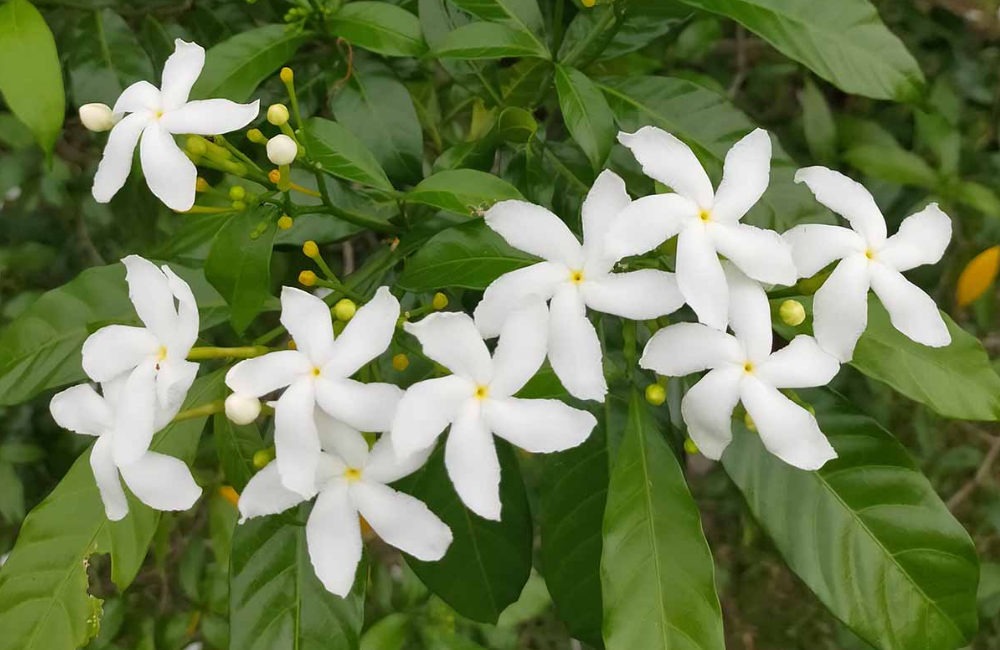
Jasmine
🌿 Botanical Source:
Jasminum grandiflorum or Jasminum sambac – A climbing plant from the Oleaceae family. Native to South Asia, especially India, and cultivated in Egypt, Morocco, France (Grasse), and China.
Jasmine absolute is extracted from the delicate white flowers using solvent extraction, due to their sensitivity to heat. It is one of the most expensive natural materials used in perfumery.
🏷️ Aromatic Family Classification:
Chypre Oriental
📐 Olfactory Architecture:
Aromatic: 10%
Fougere: 15%
Chypre: 30%
Oriental: 25%
Gourmand: 20%
👃 Olfactory Scent:
Jasmine absolute has a natural, rich, and multi-faceted aroma that embodies femininity, sensuality, and depth:
Dense and silky floral
Sweet honeyed nuance
Green-animalic (indolic) undertone
Powdery warmth in the dry-down
Subtle fruity hints
Soft oriental–balsamic edges
“Rich, warm, intensely floral, narcotic, and sweet. A carnal, indolic depth that gives it powerful character.” — IFF
Intensely floral, sweet, tenacious, with a somewhat musky and tea/honey undertone; slightly lighter than Jasmine Absolute from India, yet still very concentrated. Eden
Intensely floral, very sweet, tenacious, with a deep richness and a somewhat musky and coumarin-like undertone; a bit richer/denser than our Jasmine Absolute from Egypt. Eden
🧬 The Most Prominent Active Molecules in Jasmine Absolute:
Benzyl Acetate:
Scent: Floral – Fruity – Soft
Role: Provides a velvety floral tone and subtle fruity sweetness.
Indole:
Scent: Animalic – Deep – Slightly dirty
Role: Adds sensual depth and balances the floral sweetness.
Cis-Jasmone:
Scent: Floral – Green – Fresh
Role: Lends green floral brightness and elegance.
Methyl Anthranilate:
Scent: Fruity – Powdery – Orange blossom-like
Role: Creates a sweet, oriental marshmallow-like effect.
Linalool:
Scent: Floral – Powdery – Herbal
Role: Adds softness and harmony to the composition.
Farnesene:
Scent: Herbal – Green – Floral
Role: Balances the floral notes with a herbal-green tone.
Geraniol:
Scent: Floral – Fresh – Rosy
Role: Enhances the floral-fruity facets.
⚙️ Structural Role:
Heart Note – Jasmine absolute is used to impart:
A deep and warm floral core
Soft feminine sensuality
Balance between fruit, flower, and wood notes
A velvety transition from top to base
A captivating, rich character
It is essential in:
Luxurious floral-oriental perfumes
Bridal and celebratory scents
White floral compositions
Classic feminine fragrances
Oud-rose-jasmine blends
🎶 Olfactory Harmony:
Jasmine blends beautifully with:
Rose, Tuberose, Orange Blossom – to create rich, velvety floral bouquets
Sandalwood, Patchouli, Amber – to build a deep oriental-balsamic base
Musk, Tonka Bean, Vanilla – to enhance its sweet, sensual side
Civet, Castoreum (or their modern alternatives) – for animalic depth
Citrus Notes (Bergamot, Neroli) – to offset the richness with freshness
Oud, Incense, Labdanum – for complex oriental compositions
🧪 Synthetic Analogs:
Due to the high cost of natural jasmine, various synthetic molecules are used to replicate its character:
Hedione – A light jasmine note, evoking sunlight on petals
Methyl Dihydrojasmonate – Represents fresh jasmine brightness (widely used in Eau Sauvage, CK One)
Indolene – A clean alternative to natural indole
Jasmonyl – Evokes the sunny floral facet of jasmine
Benzyl Acetate + Linalool Blend – A technical base for recreating classic floral tones
📌 Final Notes:
Natural jasmine stands out for its complex, sensual, and evolving character, merging floral beauty, fruity sweetness, and animalic–oriental depth.
It remains a core signature ingredient in fine perfumery.
While synthetics can mimic aspects of its profile, true jasmine absolute is unmatched in richness, longevity, and emotional resonance.
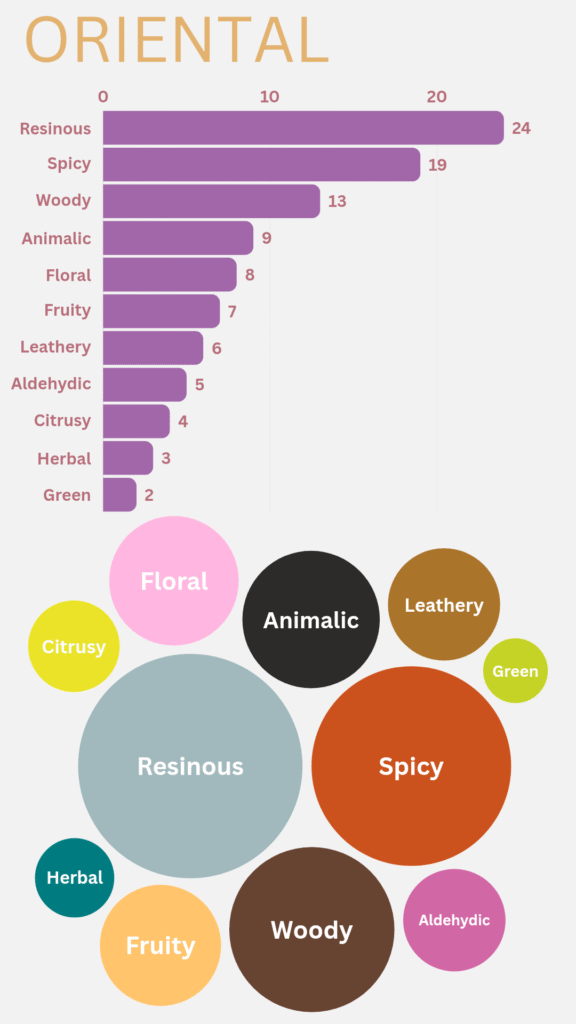
4_Oriental:
A family characterized by its warmth and richness, built on resinous materials such as olibanum and myrrh, along with accords of vanilla, amber, spices, and precious woods like sandalwood and oud. It often evokes a mysterious and sensual character, inspired by the Middle East and Asia.
It is a family rich in ingredients, complex, and often characterized by opulence. It is close to the Chypre family in terms of complexity and shares with it both ambery and floral notes.
The first perfume marketed as an Oriental fragrance was Shalimar by Guerlain. However, some sources consider Habanita by Molinard, released in 1921, to be the first Oriental perfume. Initially categorized as a leathery chypre, it was later reclassified as an Oriental fragrance.
Characteristics:
Warm, seductive and sensual.
Strong presence in winter and evening occasions.
Examples:
Shalimar Parfum Guerlain 1925, Jacques Guerlain.
Opium Yves Saint Laurent 1977, Jean Amic, Jean-Louis Sieuzac and Raymond Chaillan, Spicy Oriental.
Obsession Calvin Klein 1985, Jean Guichard, Spicy Oriental.
M7 Yves Saint Laurent 2002, Jacques Cavallier Belletrud and Alberto Morillas, Aromatic Oriental.
Oud Wood Tom Ford 2007, Richard Herpin, Woody Oriental.
Tuscan Leather Tom Ford 2007, Leathery Oriental.
The One for Men Eau de Parfum Dolce & Gabbana 2015, Olivier Polge, Aromatic Oriental.
Interlude Man Amouage 2012, Pierre Negrin, Woody Oriental.
02 L’Air du Desert Marocain Tauer Perfumes 2005, Andy Tauer, Spicy Oriental.
Chypre and Oriental share a rich and bold harmony.
Chypre carries a dry character, while Orientals bring warmth and richness. When combined, they create classic compositions with a luxurious and refined aura, as the Oriental warmth softens the dryness of the Chypre structure.
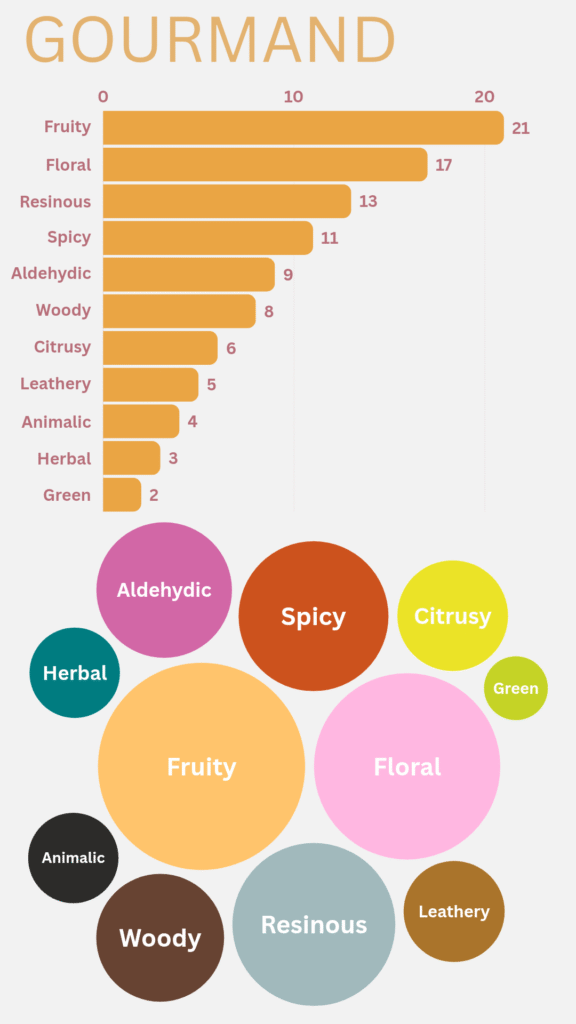
5_Gourmand:
Gourmand evokes a savory scent and stimulates the taste receptors — it doesn’t necessarily have to be sweet in flavor; it can also be sour or bitter.
It includes foods, drinks, and desserts such as: vanilla, coffee, honey, whiskey, fenugreek, cotton candy, marshmallow, caramel, chocolate, nuts, milk and even some flowers like osmanthus and tuberose, as well as sweet treats like mango, cherry, coconut, and pear.
Characteristics:
Appetizing, delicious, and alluring.
. Often warm and heavy.
. Especially appealing to younger audiences.
Examples:
Angel Mugler 1992, Olivier Cresp and Yves de Chirin, Oriental Gourmand.
La Vie Est Belle Lancome 2012, Olivier Polge, Dominique Ropion and Anne Flipo, Fruity Gourmand.
Oud Bouquet Eau de Parfum Lancome 2014, Oriental Gourmand.
The Oriental and Gourmand families share a delicious and sensual harmony.This is one of the most common combinations in modern perfumery.Gourmand notes add a delectable touch—like caramel—to the sensual warmth of Orientals, resulting in seductive fragrances ideal for winter and special occasions.
Fougere and Gourmand — an unconventional yet possible pairing. When gourmand notes are integrated into a fougere structure, they can create modern fragrances that balance herbaceous freshness with delicious sweetness, appealing to a youthful taste.
The relationship between the Chypre and Gourmand families is based on a balanced contrast.
Chypre is characterized by a dry, elegant, and earthy profile, while Gourmand adds delicious and sensual touches to the dry structure of Chypre.
Gourmand softens the austerity of Chypre, making it warmer and more comforting.The resulting composition is refined yet indulgent, appealing to modern tastes.
The relationship between the Aromatic and Gourmand families is based on a vibrant and refreshing contrast.
The Aromatic family brings clean, herbal, and green notes, while Gourmand adds sweet and delectable touches.
When combined, the fragrance achieves a balance between freshness and rich flavors, resulting in surprising and unconventional compositions—especially appealing in youthful or contemporary perfumes.
Example:
A*Men Mugler 1996, Jacques Huclier, Aromatic Gourmand.
Scandal Pour Homme Jean Paul Gaultier 2021, Quentin Bisch, Christophe Raynaud and Natalie Gracia-Cetto, Aromatic Gourmand.
Gourmand is considered one of the five primary fragrance families in the Aromatic Glance classification, alongside Aromatic, Fougère, Chypre, and Oriental.
It is a structurally and functionally independent family. While it may occasionally overlap with Oriental perfumes, its unique identity allows it to stand alone.
⚙️ Structural Role:
Gourmand fragrances are typically built on edible-based structures, using materials like vanilla, tonka, caramel, chocolate, praline, chestnut, honey, milk, burnt sugar, coffee, cognac, nuts, and more. These are not part of the traditional framework of Oriental perfumes, and they often trigger what’s called olfactory-gustatory synesthesia—a sensation where the scent feels almost “tasted.”
By contrast, Oriental perfumes are built on resins (like frankincense and myrrh), balsams, warm spices (like saffron), amber, musk, and oud.
So, Gourmand expresses food and sweetness, whereas Oriental expresses warmth and mystery.
🧪 Molecular Identity:
The core of Gourmand perfumes includes molecules such as Sotolon (found in fenugreek), Coumarin (in tonka), Vanillin, Ethyl Maltol, all of which clearly convey a sweet, edible character.
Some key Gourmand molecules include:
Ethyl Maltol: evokes the scent of burnt sugar or cotton candy.
Vanillin / Ethyl Vanillin: gives the impression of synthetic vanilla.
Coumarin: almondy, tonka-like aroma; exists in both natural and synthetic forms.
Gourmand materials are generally strong in longevity and sillage. Caramelic molecules often overpower resins and oud—they tend to be dense and diffusive. For oud to even stand out in such a formula, it’s a real challenge—unless the perfume is a pure oud-based creation.
Naturally Occurring Gourmand Molecules:
Barely roasted notes
Beeswax
Cocoa
Cognac
Coffee
Tea
Massoia lactone
Rum
Tonka bean
Vanilla
These materials have sensory characteristics similar to taste. They activate olfactory receptors in a way that’s more “gustatory” than purely aromatic. That’s why they are often classified as part of a “sensory, food-based family.”
Such materials are rarely found in traditional Oriental perfumes and instead represent a distinct aromatic spectrum tied to sugars, pastries, and fatty ingredients.
🔗 Structural Behavior – Sensory Interaction & Fusion:
Gourmand fragrances don’t easily tolerate heavy Oriental ingredients—and vice versa—for several reasons:
Gourmand compositions require soft, light bases to let sweetness shine, while classic Oriental ingredients like oud or frankincense disrupt sensory harmony when used heavily. They can mask the sugary tone and turn it into a dark balsamic or resinous effect.
Gourmand molecules are more volatile and require precise fixation, while Oriental materials are heavier and slower to evaporate, making the blend between the two chemically and harmonically challenging—unless done with great skill (as in certain works by Antoine Lie or Julien Rasquinet).
📜 Historical & Functional Evolution:
The Gourmand family was officially born in 1992 with Angel by Mugler, crafted by Olivier Cresp—making it a very recent family rooted in a chemical revolution, not an extension of traditional Oriental heritage.
Its widespread popularity in the modern market and the consistency of its structural traits earned it recognition as a distinct primary family with a clear functional profile.
In contrast, the Oriental family has existed for thousands of years across civilizations like Mesopotamia, Egypt, India, and the Islamic world.
🎨 Olfactory Expression:
Gourmand fragrances stimulate the brain’s reward centers associated with food, mimicking sweet and milky scents. They evoke comfort, warmth, joy, and nostalgia—often tied to childhood or beloved desserts.
Oriental scents stimulate different sensory pathways, evoking mystery, seduction, luxury, and a broader emotional impact. They work with more complex aromatic materials that stimulate multiple senses—not just food-related smell.
So from a psychological and physical perspective, Gourmands are more connected to emotional comfort through scent, while Orientals evoke a wider range of emotional responses.
Why do some perfumers resist separating Gourmand and Oriental?
1. Ingredient overlap: Vanilla, tonka, and synthetic amber are used in both modern Oriental and Gourmand perfumes, creating the illusion of a shared origin. But functionally, their role differs:
In Oriental perfumes, vanilla is a balsamic-warm balancer.
In Gourmands, it’s a dominant sweet-edible base.
2. Simplified classifications: Some traditional French schools still rely on broad labels like “Floral – Oriental – Woody – Fresh” and consider Gourmand a modern extension of Oriental, rather than a standalone family.
3. Lack of structural awareness: Some critics or classic perfumers don’t examine the molecular or functional differences deeply enough to distinguish the families clearly.
Final Conclusion (Compelling):
The Gourmand family is not a subset of the Oriental family, as it differs in:
Molecular structure
Sensory behavior and harmonic function
Type of raw materials (edible vs. resinous)
Temporal and cultural context of emergence
Therefore, it is a chemically, structurally, and sensorially independent family, fully deserving of its place among the modern primary fragrance families.
Vanilla
🌿 Botanical Source:
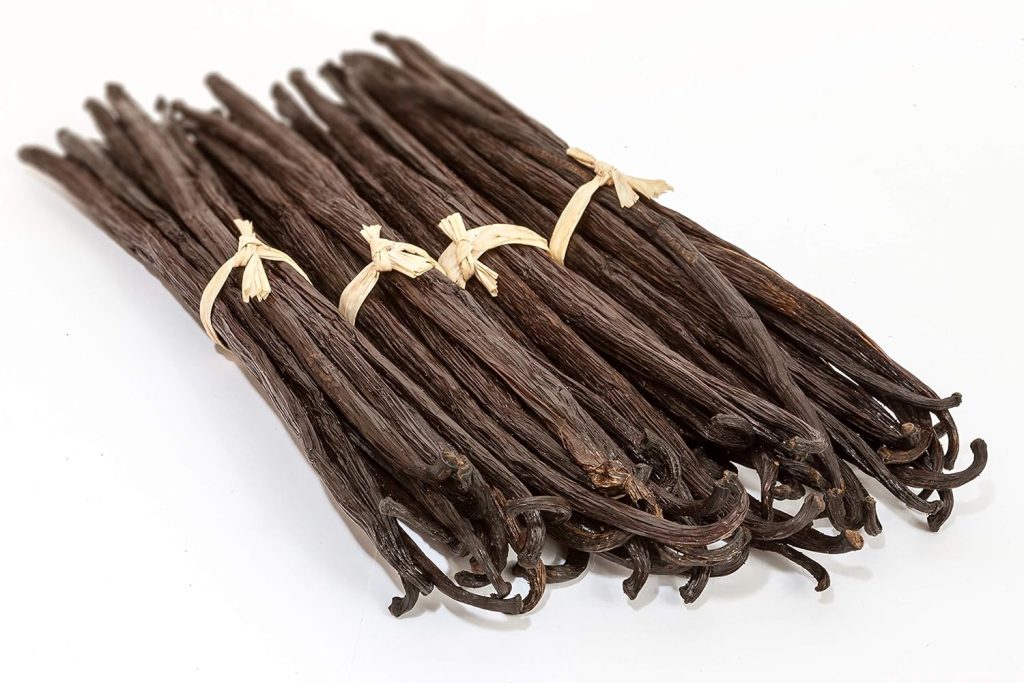
Vanilla planifolia – A climbing plant belonging to the Orchidaceae family, originally native to Mexico but now cultivated in Madagascar, Indonesia, Uganda, and Tahiti.
Vanilla is extracted from carefully dried and fermented vanilla beans to release the natural vanillin compound.
Vanilla is inherently gourmand and oriental in its application.
It is not an oriental ingredient in the historical sense like frankincense, oud, or amber, but is widely used in modern oriental perfumes as part of warm balsamic bases.
So, functionally it may belong to oriental perfumes, but not in origin or traditional structure.
When combined with spices, amber, or resins, vanilla acquires a distinctly oriental character.
Vanilla is not spicy by molecular structure or scent, but it blends harmoniously with spices and enhances their warmth.
🏷️ Family Classification:
Balsamic Gourmand
📐 Olfactory Architecture:
Gourmand: 40%
Oriental: 30%
Chypre: 25%
Fougere: 20%
Aromatic: 5%
👃 Olfactory Scent:
Creamy, sweet, warm vanilla
Balsamic, soft resinous tone
Slightly powdery or custard-like
Sometimes with nuances of soft leather or mild spice
Rich and “edible,” blending sugary warmth with the softness of dried floral notes
Vanilla provides a warm, gourmand base that embraces the senses. It is widely used to deepen oriental, tobacco, and amber accords.
> “Very rich, sweet, dense, characteristic vanilla aroma with a faint bitter undertone, chocolate-like nuances, and a very deep balsamic body note.” – Eden Botanicals
🧬 The Most Prominent Active Molecules in Vanilla:
1. Vanillin
Scent: Sugary, creamy, gourmand vanilla
Role: The primary molecule responsible for vanilla’s familiar scent
2. p-Hydroxybenzaldehyde
Scent: Soft powdery – lightly floral
Role: Enhances sweetness and balances between sugar and floral tones
3. Vanillic Acid
Scent: Sweet – mildly acidic – deep
Role: Provides equilibrium between vanilla and balsamic resin
4. Ferulic Acid
Scent: Warm, soft cinnamon-like
Role: Reinforces the oriental–gourmand–spicy warmth
5. Coumarin (present in trace amounts in some varieties)
Scent: Vanilla – almond – tobacco
Role: Strengthens harmony with ingredients like tonka and tobacco
⚙️ Structural Role:
Base / Heart Note
Vanilla is primarily used as a base note, sometimes appearing in the heart of the composition.
It provides:
Deep warmth
Sweet, balsamic softness
A seductive, feminine touch
A powerful gourmand effect
🎶 Olfactory Harmony:
Vanilla blends beautifully with:
Tonka Bean – for a natural synergy in creating a vanilla–almond–balsamic base
Labdanum & Benzoin – to build a rich, ambered oriental warmth
Cinnamon & Clove – for sweet spice enhancement
Tobacco & Cocoa – for a delicious, gourmand-tobacco accord
Musk – to soften and extend the base
Patchouli & Vetiver – balancing earthy, chypre tones
Jasmine & Orange Blossom – to add a floral-sensual vanilla heart
Oud & Leather – to counterbalance sweetness and add smoky depth
🌿 Botanical Source:
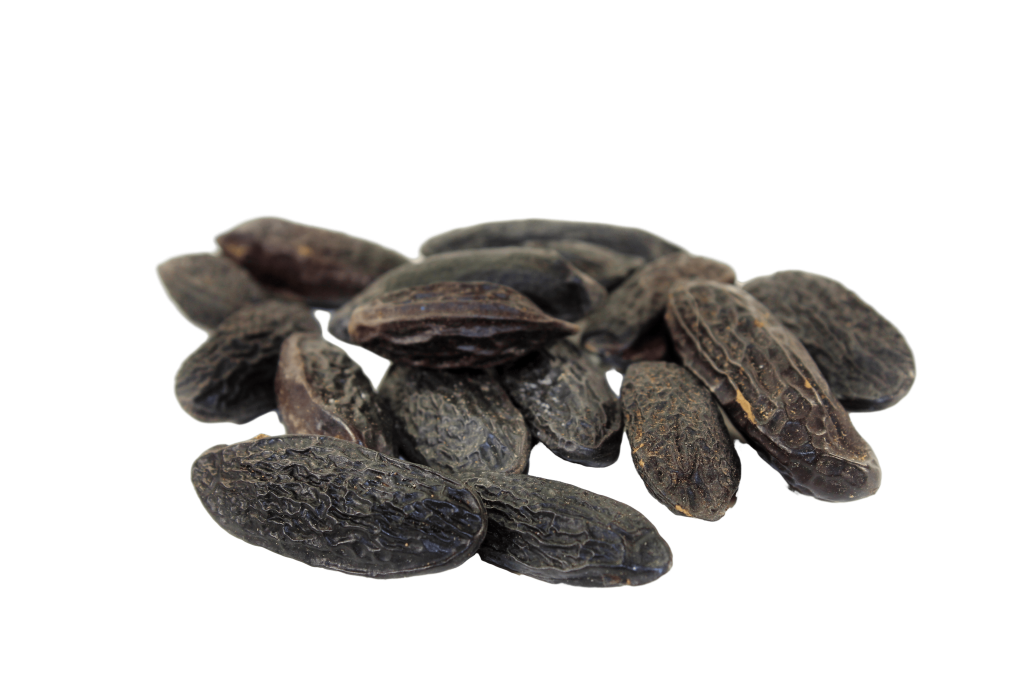
Dipteryx odorata: A tropical tree belonging to the legume family Fabaceae, native to South America, especially Brazil and Venezuela.The seeds are dried and fermented to release coumarin, the primary aromatic compound.
🏷️ Aromatic Family Classification: Oriental Gourmand
📐 Olfactory Architecture:
Aromatic: 5%
Fougère: 10%
Chypre: 5%
Oriental: 35%
Gourmand: 45%
👃 Olfactory Scent:
Warm, sweet, balsamic, vanillic, soft spicy (reminiscent of cinnamon due to the presence of coumarin), almondy, tobacco-like, and dry herbal.
Very rich, caramel-like, powdery-sweet aroma of new mown hay with a warm herbal and soft tobacco-like undertone; very tenacious. Eden
🧬 The Most Prominent Active Molecules in Tonka Beans:
1. Coumarin Approximate concentration: About 1–3% of the dry seed weight, but can reach up to 10% in some cases.Scent: Sweet, creamy, vanilla-almond, reminiscent of dried hay.Aromatic role: The key molecule responsible for the gourmand, vanillic, and warm character.
2. Dihydrocoumarin
Scent: Milky, soft, creamy.Role: Enhances the creamy and smooth aspects of tonka.
3. o-Hydroxyacetophenone
Scent: Powdery, slightly sweet, balsamic.Role: Adds depth and a balsamic nuance to the scent.
4. Cinnamic Acid Derivatives
Scent: Resembling cinnamon and vanilla, warm.Role: Bridges spicy and sweet notes, enhancing the oriental-gourmand character.
5. Vanillin (in cases of synthetic extraction or natural fermentation)
Scent: Classic vanilla.Role: Contributes to the sweet vanillic profile, but usually in much smaller amounts than coumarin.
⚙️ Structural Role:Heart / Base NoteTonka is used to soften the base, and to add a warm, sweet, balsamic tone, especially in:Oriental fragrancesTobacco-based perfumesGourmand compositionsAmber accordsLeather scentsClassic and modern Fougères (as a natural substitute for synthetic coumarin)
🎶 Olfactory Harmony:
Tonka harmonizes well with:
Vanilla (a natural synergy enhancing warmth and sweetness)Labdanum (for gourmand-amber bases)
Tobacco (to increase the almondy–dry–herbal sweetness)
Soft woods like sandalwood and cashmereLeathery notes (to reduce harshness and add a warm femininity)
Sweet spices: cinnamon, allspice (pimento), nutmeg
White florals, especially jasmine and lilac (for soft gourmand depth)
Musk (to enhance base softness and balance)
Patchouli
Oud
Amber
Cocoa
Cinnamon
Almond
cardamom
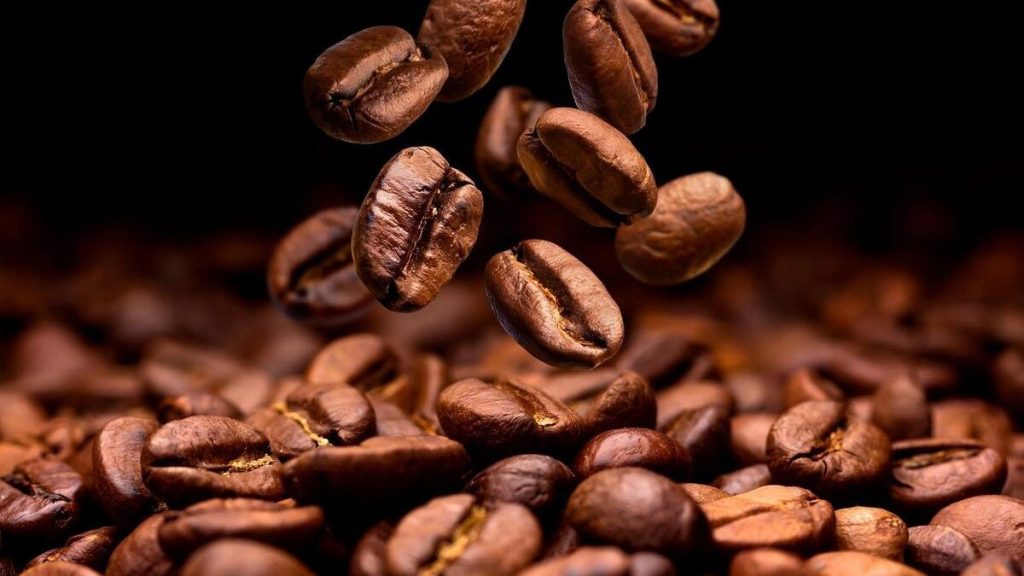
Coffee
🌿 Botanical Source:
Coffea arabica – An evergreen shrub from the Rubiaceae family. Originally native to Ethiopia, it is now widely cultivated in South America, Africa, Yemen, and Asia.
The aromatic oil is extracted from roasted coffee beans through distillation or solvent extraction. Sometimes, unroasted bean extracts or flavor concentrates are used to impart a different olfactory profile.
🏷️ Aromatic Family Classification:
Gourmand
📐 Olfactory Architecture:
Aromatic: 20%
Fougere: 10%
Chypre: 15%
Oriental: 15%
Gourmand: 40%
👃 Olfactory Scent:
The scent of coffee in perfumery is considered one of the deepest and most intimate gourmand notes—warm, roasted, bitter, with a subtle smoky nuance and a dark earthy undertone.
It holds a delicate balance between:
Bitter blackness: reminiscent of espresso or strong Turkish coffee.
Slightly burnt character: like heavily roasted, almost charred coffee beans.
Balsamic–sweet facet: which emerges when coffee is blended with vanilla, caramel, or chocolate.
Earthy roughness: evoking raw green coffee or damp soil tones.
The aroma may vary depending on the extraction method:
Green Coffee Oil: grassy, mildly acidic, and closer to raw nuts.
Roasted Coffee Extract: dark, smoky, balsamic, leaning toward bitter cocoa nuances.
Sweetened Coffee (in gourmand compositions): shows facets of vanilla, caramel, or creamy milk, giving it a rich and cozy warmth.
> “Rich, roasted, bittersweet aroma with dark chocolate, nutty undertones and a warm, enveloping depth.” — Perfumer’s Apprentice
“Strong, rich aroma of dark roasted coffee.” — Eden Botanicals
“Strong, rich, smooth, earthy aroma of dark roasted coffee with light smoky undertones.” — Eden Botanicals
🧬 The Most Prominent Active Molecules in Coffee Oil:
Furfuryl Mercaptan
Scent: Dark coffee – Roasted – Bitter
Role: Responsible for coffee’s sharp, roasted signature.
Furaneol (Strawberry Furanone)
Scent: Caramel – Burnt – Warm fruity
Role: Adds a warm sugary touch and gourmand base.
Guaiacol & Vinylguaiacol
Scent: Smoky – Woody – Roasted
Role: Reinforces the burnt, smoky depth.
Caffeol
Scent: Pure coffee – Oily – Roasted
Role: A natural compound generated during roasting that defines the coffee character.
Maltol
Scent: Toast – Burnt sugar – Pudding
Role: Enhances the gourmand aspect of coffee-based scents.
⚙️ Structural Role:
Typically used in the heart or base of the fragrance.
Provides:
Roasted warmth
Burnt sweetness
A comforting and emotional feeling
A rich, oriental gourmand character
Ideal for:
Winter or evening fragrances
Dessert or chocolate-themed perfumes
Complex oriental blends
Contemporary gourmand compositions
🎶 Olfactory Harmony:
Coffee blends beautifully with:
Vanilla, Tonka, Cacao: To amplify the sweet, luxurious profile
Oud, Patchouli, Labdanum: For smoky, deep, oriental warmth
Cinnamon, Cardamom, Clove: To enrich the spiced, roasted character
Sandalwood, Cedarwood: To build a warm woody base
Amber, Benzoin: For caramelized and ambery nuances
Rose, Tuberose: For unconventional floral-gourmand combinations
Rum, Whiskey Notes: For a boozy, opulent feel
Citrus Zests (Bergamot, Orange): To offer a bright, contrasting top
🧪 Synthetic Analogs / Molecules:
Cafearone: A precise imitation of roasted coffee aroma
Tonalid with Furaneol & Maltol: For a creamy cappuccino-like gourmand touch
Coffee CO₂ Extract: A pure, high-quality coffee concentrate
Methylcyclopentenolone (Maple Lactone): Adds a caramelized, burnt sugar and coffee feel
📌 Final Notes:
The scent of coffee in perfumery is often indirect, achieved through blending multiple molecules.
Coffee aroma molecules mostly belong to furans, phenols, and pyrazines, giving it that roasted, gourmand character.
Coffee is a rare and precious ingredient in perfumery, known for its ability to evoke emotional warmth and intimacy.
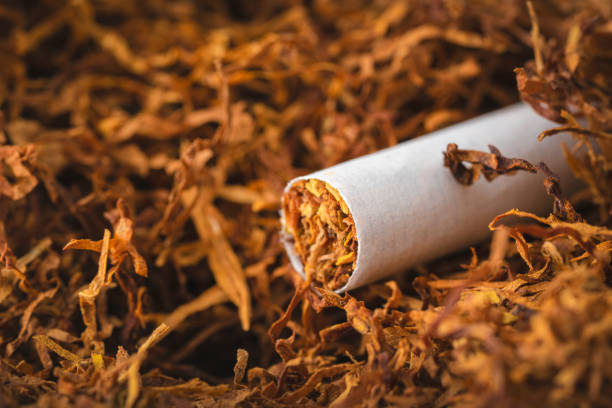
Tobacco
🌿 Botanical Source:
Nicotiana tabacum – A herbaceous plant from the Solanaceae (nightshade) family, originally native to the Americas. Its leaves are dried and then cured or fermented through various processes to extract the distinctive aromatic profile of tobacco.
Raw tobacco is not used directly in perfumery. Instead, its scent is extracted as Tobacco Absolute from the dried leaves using solvent extraction or enfleurage. It’s often blended with other aroma materials to soften its intense character.
🏷️ Aromatic Family Classification:
Oriental Gourmand
📐 Olfactory Architecture:
Aromatic: 10%
Fougere: 10%
Chypre: 20%
Oriental: 35%
Gourmand: 25%
👃 Olfactory Scent:
Tobacco’s aroma is rich, warm, and deep—evoking masculinity, sensuality, and opulence.
Dried, honeyed leaf aroma
Slightly leathery and earthy undertones
Dark sweetness reminiscent of scorched vanilla or dates
Spicy, balsamic, smoky nuances
Occasionally reminiscent of caramel or black tea
A perfect balance of mature sensuality and oriental warmth
Tobacco in perfumery embodies the essence of depth, maturity, and Eastern warmth. It is a dark, dried aroma sweetened by whispers of honey or warm caramel, steeped in the silence of ancient soil.
It opens with a dry vegetal flicker—like meticulously cured tobacco leaves—rising with a bittersweet, resinous, and subtly sweet aroma akin to a blend of:
Dark honey dripping over brittle leaves
Slowly burning smoky wood
A warm balsam intertwined with moist hay
“Warm, slightly sweet, rich and dry-leathery. Evokes vintage cigar boxes, honeyed hay, and spiced woods.” — Perfumer’s Workshop
“Woody, mossy, sweet hay-like, warm herbaceous aroma reminiscent—when diluted—of fine pipe tobacco; very tenacious.” — Eden Botanicals
🧬 The Most Prominent Active Molecules in Tobacco Absolute:
Nicotin
Scent: Herbal – Smoky – Bitter
Role: Adds a bitter, earthy-smoky depth – rarely used in its pure form due to toxicity.
Caryophyllene
Scent: Spicy – Woody – Balsamic
Role: Adds clove-like warmth and enhances the balsamic character.
Furfuryl Alcohol
Role: Toasted – Roasted – Sugary
Role: Imparts roasted caramel or dark coffee-like nuances.
Coumarin
Scent: Powdery – Sweet – Hay-like
Role: Adds soft, dry vanilla sweetness.
Isobutyl Quinoline
Scent: Leathery – Earthy – Dark
Role:Gives sharp leathery and earthy depth.
Ionones & Damascones
Scent: Floral – Fruity – Berry-like
Role: Softens the blend and adds gentle floral nuance.
⚙️ Structural Role in Perfumery:
Base Note / Heart Note – Tobacco is used to bring:
A warm, leathery aromatic base
Long-lasting richness
Sensual, masculine oriental warmth
Attractive dryness reminiscent of smoked woods
A balance between sweetness and dark complexity
Commonly found in:
Oriental-leathery fragrances
Refined masculine perfumes
Winter or evening compositions
Vanilla–spice–smoke accords
🎶 Olfactory Harmony – Tobacco Pairs Well With:
Tonka Bean, Vanilla, Honey: Accentuates sweet, warm sensuality
Cinnamon, Clove, Nutmeg: Enhances the spicy oriental side
Leather, Suede, Oud: Amplifies the smoky-leathery character
Amber, Labdanum, Myrrh: Builds a balsamic–resinous base
Vetiver, Patchouli, Cedarwood: Balances sweetness with dry woods
Rose, Tuberose, Jasmine: Creates contrast between floral and dark masculine tones
Cocoa, Coffee, Prune: Adds a modern, dark gourmand nuance
🧪 Synthetic Analogs / Safe Tobacco Alternatives:
Due to regulatory restrictions and nicotine toxicity, synthetic substitutes are often used in perfumery:
Tobacco Pyrazines: Molecules mimicking roasted, smoky tobacco
Tobacarol: A synthetic tobacco–caramel blend
Tabanone: Replicates the cured leaf aroma
Coumarin: Commonly used in sweet tobacco-style fragrances
Castoreum & Leather Molecules: Reinforces animalic–leathery tobacco facets
📎 Additional Notes:
Tobacco in perfumery does not reflect the scent of cigarettes; it’s usually modeled after fine pipe tobacco or luxury cigar boxes.
It is typically used in the Absolute form and is a rich source of Megastigmatrienones, molecules used in synthetic tobacco accords.
📌 Final Notes:
What makes tobacco special in perfumery is its balance of dark allure and warm sweetness. It evokes memories of classic masculinity and smoky comfort.
Although the raw material is rare and restricted, its olfactory signature remains one of the most powerful themes in perfumery.
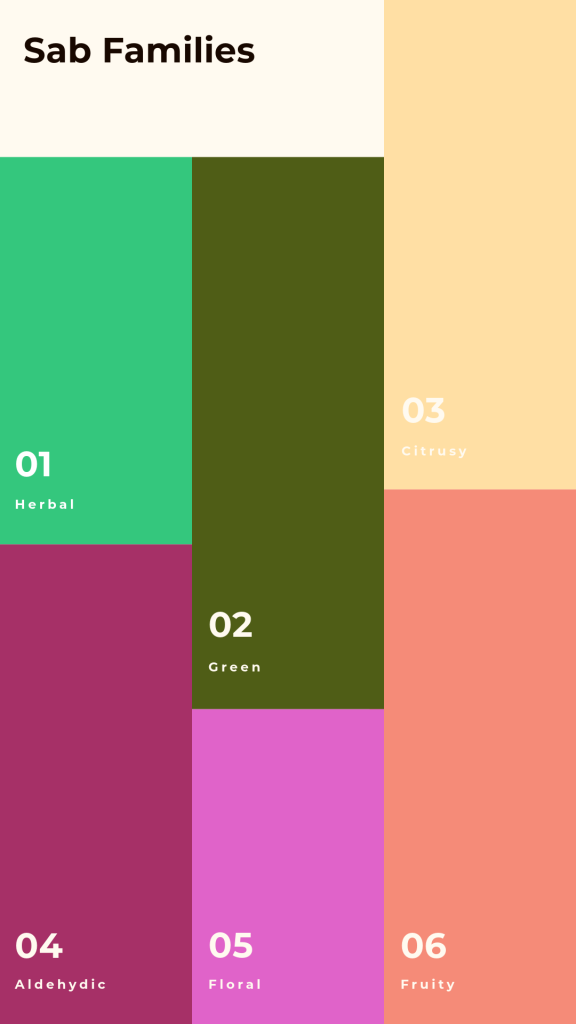
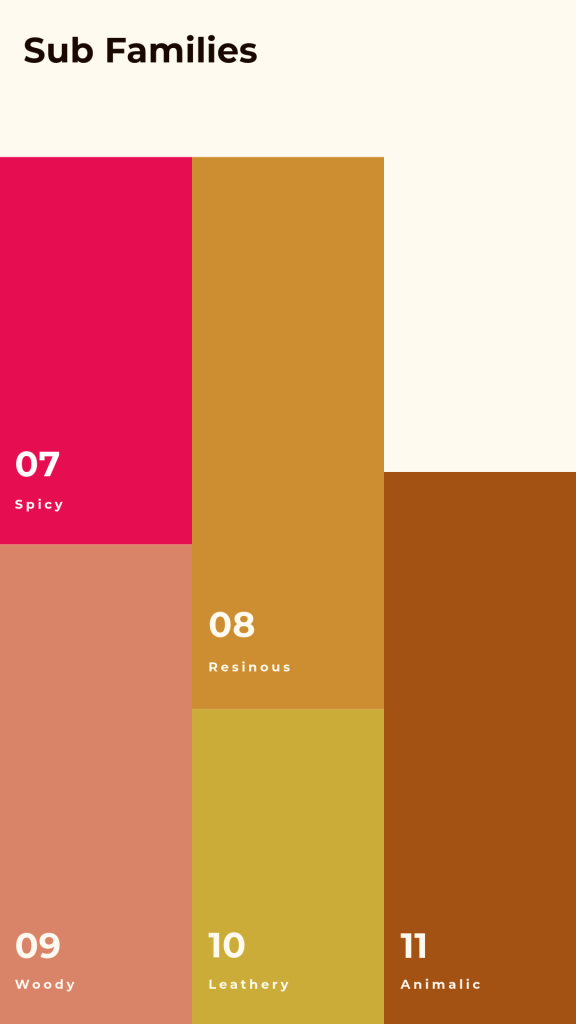
Under these main fragrance families, there are ten sub-families, classified according to their relationship and harmony with one another. They are as follows:
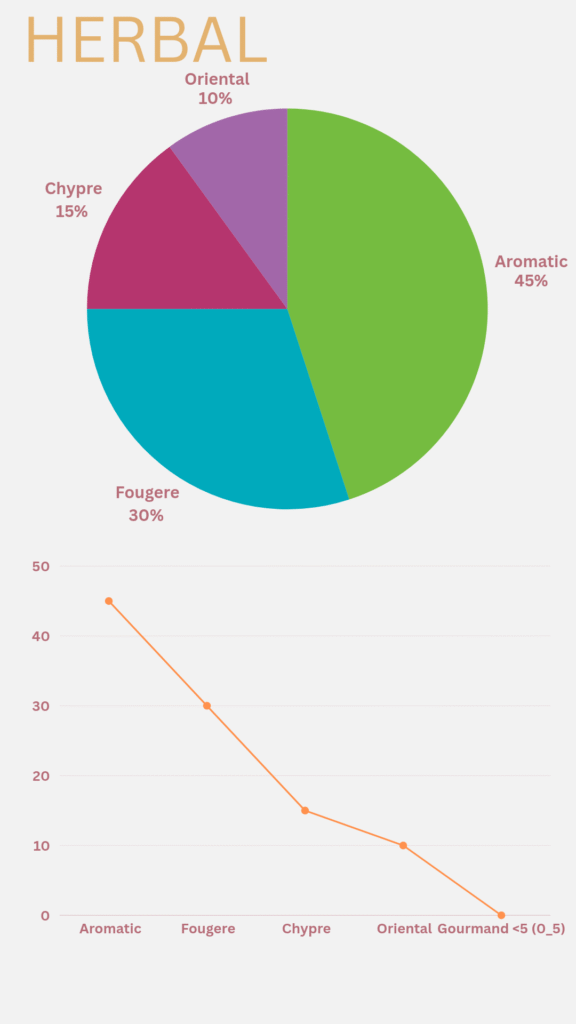
1. Herbal: Extracts from aromatic herbs, often used in medicine or cooking.
Examples: Lavender, Rosemary, Thyme, Sage, Mint and Basil.
They evoke mental freshness, clarity, balance, and sometimes relaxation or a therapeutic sense of purity.
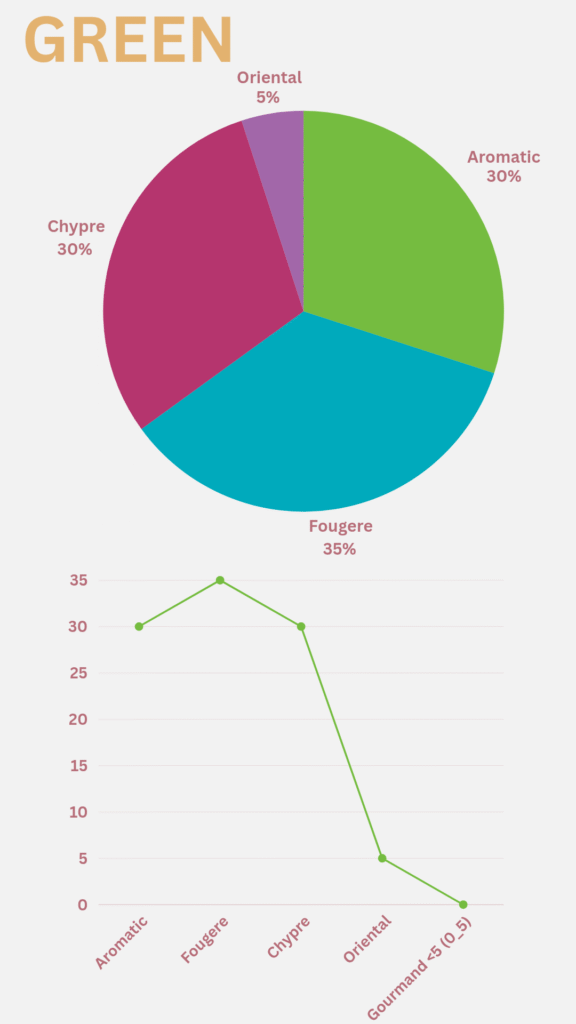
2. Green: Fresh green scents composed of fresh leaves, stems, buds, and green parts of plants that are not necessarily aromatic.
Examples: Violet leaf, cucumber and galbanum.
They convey a sense of coolness, vitality, modernity and pure nature.
Herbal = Aromatic herbal, warmer and deeper, traditionally used.
Green = Vegetal green, more moist and fresh, expressing raw and modern nature.
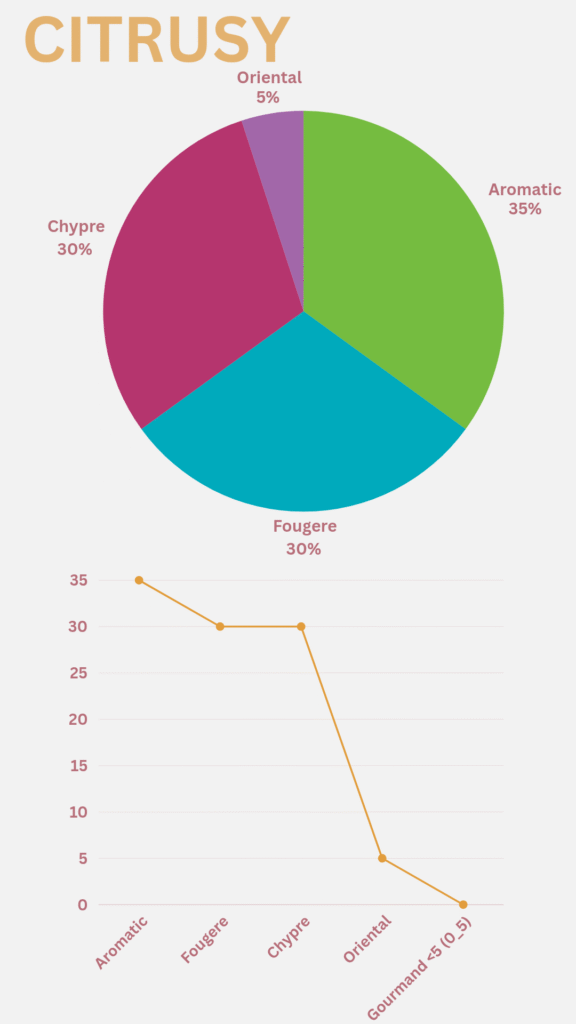
3. Citrus
Primary Classification:
The Citrus family belongs to the Aromatic primary family due to its fresh, volatile nature and its molecular richness in terpenes and aromatic compounds.
General Description:
The Citrus family expresses brightness, freshness, vitality, and purity. It is one of the oldest families used in perfumery and remains fundamental in both classical and modern compositions. Citrus materials are widely used to open a fragrance with a burst of freshness and energy.
Molecular Identity:
Citrus notes rely primarily on highly volatile natural molecules such as:
Limonene
Citral
Bergapten
Linalool
Geraniol
These molecules are typically extracted from citrus peels through cold pressing or steam distillation.Function in Fragrance Structure:Primarily used in the top notes of a fragrance.They provide immediate freshness and clarity.They enhance the volatility and brightness of the opening.
Olfactive Compatibility:
Blend seamlessly with Aromatic, Floral, Fougère, Chypre, and Light Spicy families.
Commonly used in masculine, unisex, and summer-oriented fragrances.
Notable Citrus-Based Fragrances:
Acqua di Parma Colonia by Acqua di Parma (1916).
Eau d’Orange Verte Hermès (2009), Jean-Claude Ellena.
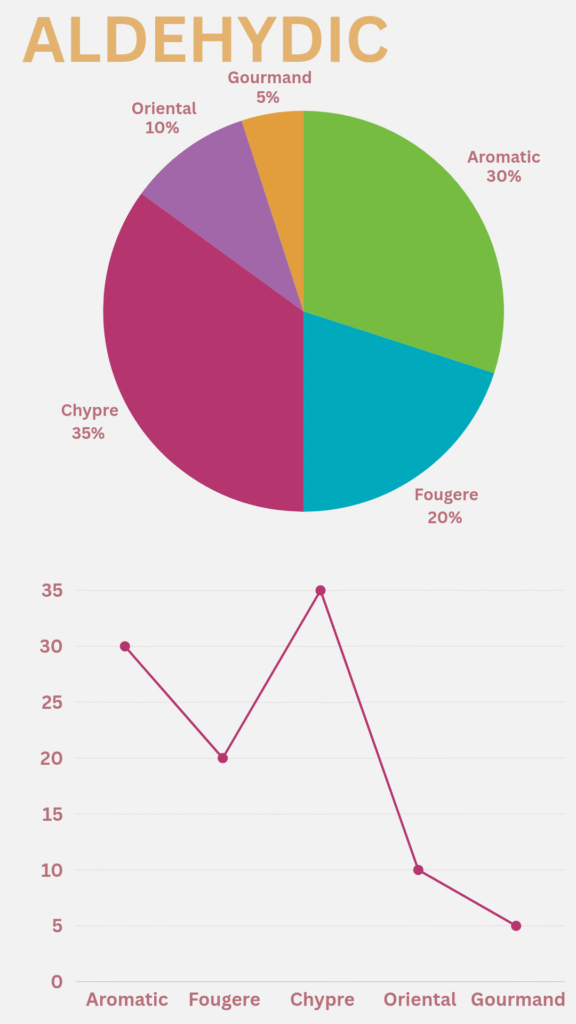
4. Aldehyde
Why are Aldehydes considered an independent Fragrance Sub-family?
1. Unified Chemical Structure:
Aldehydes are a clearly defined chemical family characterized by a consistent functional group (–CHO). Although they vary in carbon chain length, they all share this structural identity, which results in similar behavior in terms of scent and physical response.
2. Distinct and Diverse Olfactory Spectrum:
Aldehydes encompass a wide range of olfactory impressions—metallic, waxy, soapy, fruity, citrusy, crisp, cold…
These variations stem from differences in chain length and saturation, yet all trace back to a common molecular origin.
3. Structural Impact on Fragrance Design:
Aldehydes are not merely a “note”; they serve as a structural element in fragrance architecture.
Example: In perfumes like Chanel No. 5, aldehydes are not just a layer—they form the very identity and character of the scent.
5. Floral
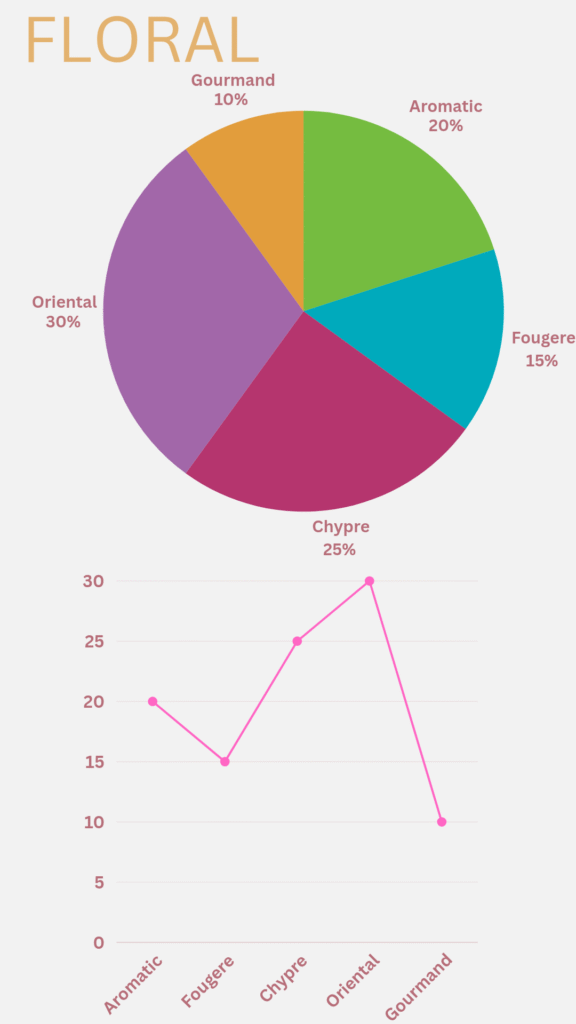
The floral family is considered one of the most common and widespread fragrance families in the world of perfumery. It represents a sensual, romantic, and aesthetic expression often associated with femininity, purity, freshness, and at times, even luxury. However, it is not a family built upon a unified molecular structure or an independent olfactive backbone. Instead, it represents a wide spectrum of natural and imaginative materials that are often used as decorative or heart notes to impart a specific character within a fragrance.
Some experts and perfumers classify it as a primary fragrance family due to its richness, variety of styles, and emotional expressiveness.
It harmonizes beautifully with Oriental, Woody, Fougère, Aromatic, and even Gourmand families.
Floral notes are often used as a bridge or central axis in many compositions.
We can divide floral notes as follows:
Powdery: Iris, violet, heliotrope, lilac, freesia, and mimosa.
Creamy: Tuberose, datura, and tiare flower.
Green: Narcissus, violet, lily of the valley, hyacinth, and gardenia.
Oriental: Damask rose, jasmine, and orange blossom.
Fruity or Citrusy: Osmanthus, ylang-ylang, frangipani, magnolia, and honeysuckle.
Spicy: Tobacco flower, wisteria, and carnation.
Aromatic: Lavender and geranium.
J’adore by Dior (1999), Calice Becker.
Carnal Flower Frederic Malle (2005), Dominique Ropion
Delina Parfums de Marly (2017), Quentin Bisch.
Damask Rose
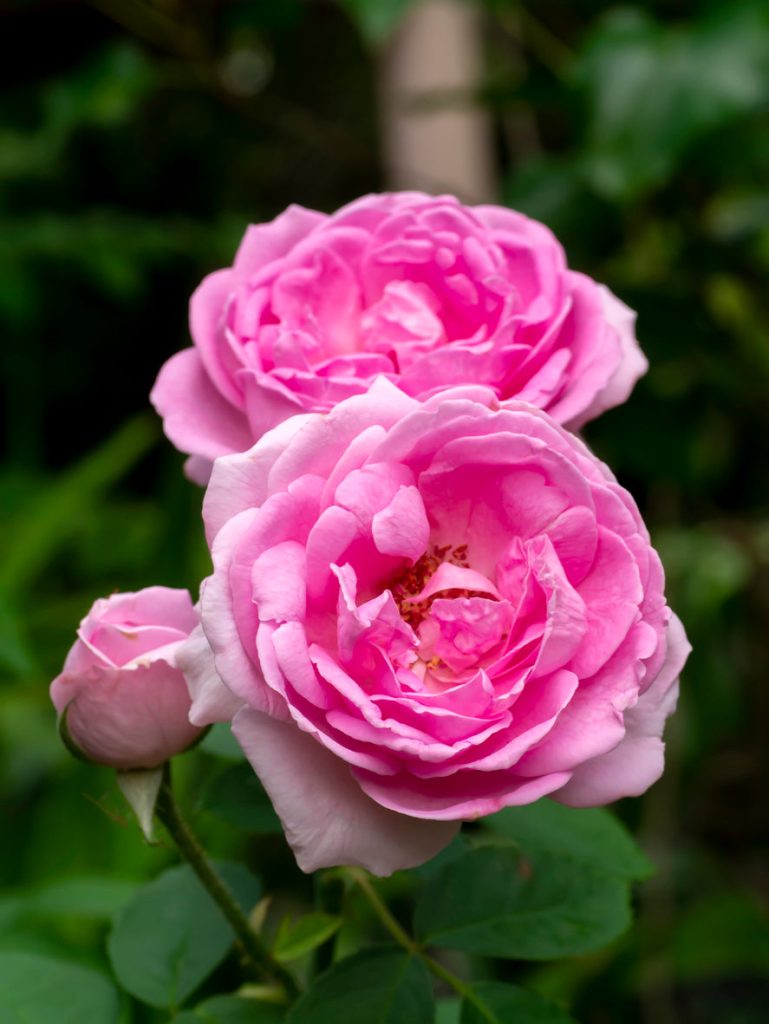
🌿 Botanical Source:
Rosa × damascena – A perennial shrub from the Rosaceae (rose) family.
Its origin is believed to trace back to the Middle East, and today it is primarily cultivated in Bulgaria (Rose Valley), Turkey, Iran, and Morocco.
Rose Otto (essential oil) is extracted via steam distillation, while Rose Absolute is obtained using organic solvents from freshly picked blossoms, harvested at dawn during the short blooming season.
This flower is a symbol of romance and beauty, and is among the rarest and richest raw materials in perfumery.
🏷️ Aromatic Family Classification:
Floral Oriental
📐 Olfactory Architecture:
Aromatic: 15%
Fougere: 15%
Chypre: 20%
Oriental: 25%
Gourmand: 25%
👃 Olfactory Scent:
Damask rose features a velvety, floral aroma that is deep and warm, with fruity, balsamic, and light herbal nuances.
A rich, fruity-floral softness (sometimes reminiscent of red berries or apricot).
Light green herbal facets, soft balsamic honeyed warmth, and sheer powdery notes.
Some trained noses detect very subtle animalic nuances (in natural rose oil) that add depth and mystery.
A rich, opulent, and multi-faceted floral aroma – velvety, honeyed, slightly spicy, with a subtle green nuance. An olfactory poem in itself.
Warm, sweet floral, deep and slightly animalic, with notes of tart dried fruit, tea, and leather that linger into the drydown. – Eden
🧬 The Most Prominent Active Molecules in Rose Oil:
Citronellol
Scent: Rosy – Fruity – Soft
Role: Provides the soft, classic fresh rose feel.
Geraniol
Scent: Floral – Apricot-like – Soft
Role: Adds sweetness and radiance to the floral character.
Phenylethyl Alcohol
Scent: Powdery – Floral
Role: Enhances smoothness and contributes to evaporation stability.
Nerol & Linalool
Scent: Soft herbal – Citrus-floral
Role: Adds refreshing green touches and a gentle aromatic sparkle.
Eugenol (in some varieties)
Scent: Spicy – Floral – Clove-like
Role: Adds warm, spicy-floral depth to the oil.
⚙️ Structural Role:
Heart Note – Damask rose is most often used as a mid-note to bring:
Romance and emotional richness
Luxurious powdery softness
Delicate sweet floral balance
Long-lasting visual and temporal diffusion
A dynamic interplay between fruit, florals, and balsamic warmth
It is a core component in:
Classic floral perfumes
Floral-oriental compositions
High-concentration luxury blends
Powdery and ambery fragrances
🎶 Olfactory Harmony:
Damask rose blends beautifully with:
Oud & Incense: to create luxurious and seductive oriental fragrances
Patchouli & Amber: to enhance the balsamic, deep side of rose
Sandalwood & Iris: for a silky, powdery base
Citrus (Bergamot, Grapefruit): to brighten and refresh the floral bouquet
Vanilla, Tonka, Benzoin: for romantic gourmand creations
Fruits (Raspberry, Plum, Peach): for a soft, sensual allure
Spices (Cinnamon, Cardamom, Clove): to add complexity and richness
🧪 Synthetic Analogs (Molecular Replacements):
Due to the high cost of natural rose oil, accurate synthetic alternatives are often used to replicate its aromatic spectrum:
Rose Oxide: Adds a distinct metallic–green brilliance
Phenylethyl Alcohol (isolated): A soft powdery-floral note
Damascenone: A highly potent molecule giving a rosey–fruity–honeyed nuance
Citronellyl Acetate: A refreshing fruity-rosy note for balance
Geranyl Acetate: Mimics the floral–herbal side of rose
Orris Butter
🌿 Botanical Source:
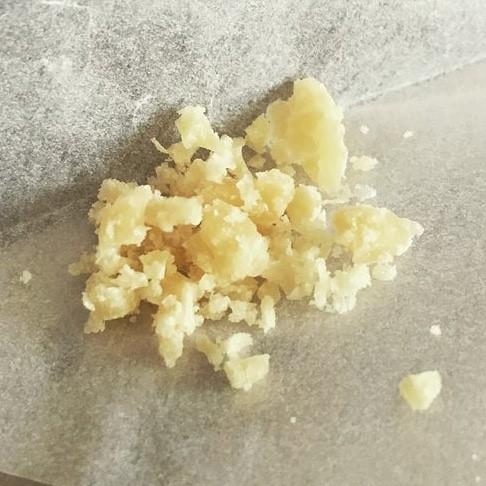
Iris germanica / Iris pallida – A perennial plant from the Iridaceae family, native to Europe (Italy, France, Slovenia). Orris Butter is extracted from the rhizomes of the iris plant after being harvested and dried for no less than 3 to 5 years. The roots are ground and the butter is extracted via steam distillation or solvents. This yields a soft, waxy substance considered one of the rarest and most expensive raw materials in perfumery.
🏷️ Aromatic Family Classification:
Powdery Floral
📐 Olfactory Architecture:
Aromatic: 15%
Fougère: 15%
Chypre: 35%
Oriental: 30%
Gourmand: 5%
👃 Olfactory Scent:
Orris Butter is distinguished by a refined powdery aroma, evoking the feeling of soft skin, with floral and earthy nuances and subtle hints of violet and carrot:
Refined, clean powderiness
Soft floral tone (reminiscent of violet)
Cool earthiness
A hint of carrot (due to carrot-related molecules)
Oily – creamy – waxy texture
Reminiscent of luxurious cosmetics
Evokes a sense of pure luxury and noble clarity
> “A soft, velvety, floral-powdery note with elegant dryness, reminiscent of violet and suede.” — Firmenich
“Delicate, sweet, warm, powdery-floral aroma reminiscent of violet flowers with mellow woody undertones; very tenacious, has excellent fixative value.” — Eden Botanicals
🧬 The Most Prominent Active Molecules in Orris Butter:
Irone Isomers (α, β, γ-irone)
Scent: Powdery – violet – earthy
Role: The key molecules responsible for the core scent of orris; they give it its noble violet-powdery depth.
Ionones (α-ionone, β-ionone)
Scent: Violet – floral – light carrot
Role: Enhance the floral nuance and bring added softness reminiscent of violet and cosmetic accords.
Cis-γ-Decalactone
Scent: Milky – peachy – soft
Role: Adds a creamy texture and silky feel; often used to support the fruity undertones within orris.
⚙️ Structural Role:
A base note, though its scent emerges early in the composition:
Provides long-lasting, refined powderiness
Smoothly bridges the top, heart, and base notes
Acts as a natural fixative for floral and powdery compositions
Brings silent nobility and understated elegance to the fragrance
Softens harsh or synthetic notes
Adds a suede or luxury-makeup-like texture
A key material in:
Powdery floral perfumes
Leather and makeup-inspired fragrances
Iris – violet – powdery compositions
Soft, elegant oriental perfumes
🎶 Olfactory Harmony:
Orris Butter harmonizes beautifully with:
Rose, Violet, Heliotrope – to create romantic powdery florals
Sandalwood, Cedarwood – for a soft balance between wood and powder
Vanilla, Tonka, Benzoin – for deep, sweet creaminess
Leather, Suede – for a luxurious powdery-leathery accord
Citrus (Bergamot, Neroli) – for a radiant and soft opening
Ambrette, Musk – to amplify the cottony-leathery undertone
🧪 Synthetic Analogs / Related Molecules:
Due to the rarity and cost of natural Orris Butter, synthetic substitutes are often used:
Methyl Ionone: Powdery – violet – synthetic
Alpha-Isomethyl Ionone: Moderately floral-powdery spectrum
Iralia®, Irione®, Hedione®: Components that enhance the violet-makeup character
📌 Final Notes:
Orris Butter is a quiet yet enchanting material, giving a fragrance a meditative, emotional depth.
It reflects “balanced femininity” and “quiet luxury”.
Its preparation takes years, making it a symbol of patience and precision in the perfume world.
6. Fruity
Primary Classification:
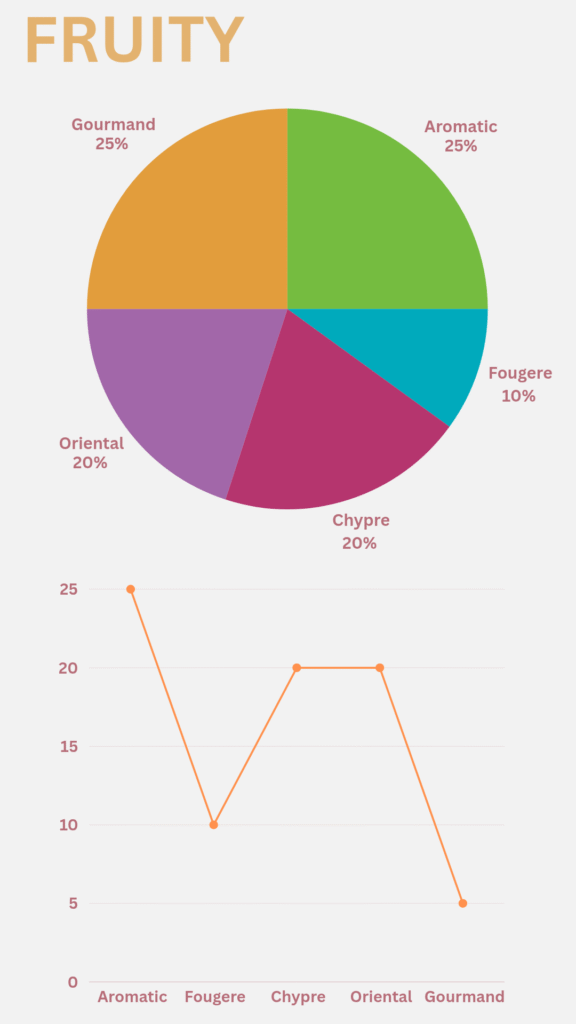
The Fruity family largely belongs to the Gourmand and Oriental families, adding delicious and seductive aesthetic touches to a fragrance.
Molecular Identity:
This is a heterogeneous olfactive family from a molecular standpoint, built on a mix of:
Esters – Responsible for the natural fruity character, such as ethyl butyrate (pineapple note) or octyl acetate (peach note).
Lactones – Impart creaminess and density, such as γ-undecalactone (peach) and δ-decalactone (apricot).
Fruity aldehydes – Such as C-10 aldehyde (sweet orange scent).
Synthetic or natural fruity notes, sometimes extracted from juices or fruit concentrates.
Function in Fragrance Structure:
Often used in the top or heart of the fragrance depending on their weight and intensity.
Provide a modern, delicious, or youthful impression.
Sometimes act as a bridge between florals and gourmand bases or add a playful and attractive nuance.
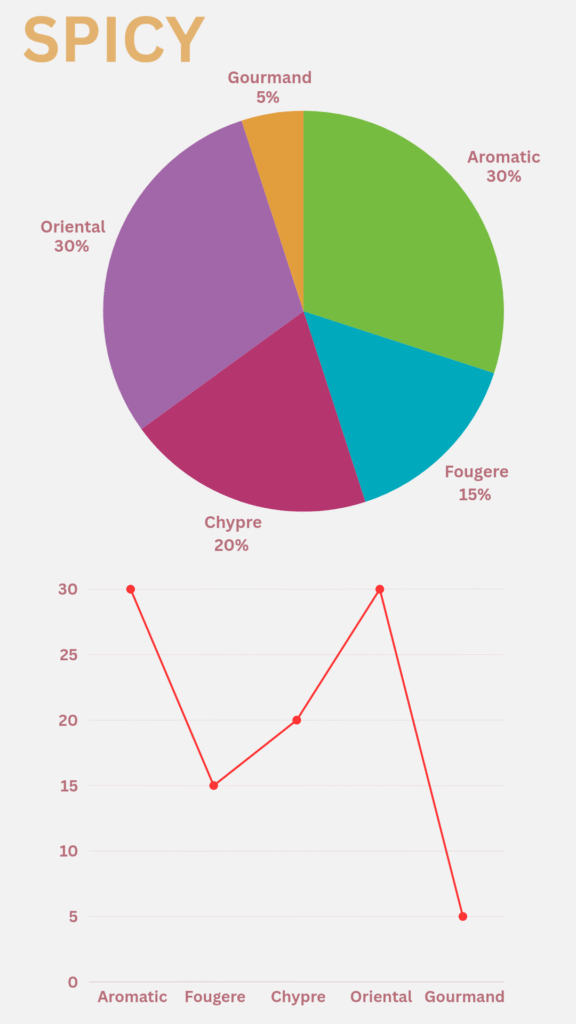
7. Spicy
Spicy fragrances rely on spices as their primary aromatic source. This is a rich and diverse family that can lend a fragrance a warm, fresh, or even creamy-sweet character, depending on the type of spice, the composition, and how it’s used.
Spices are employed to balance sweetness, deepen florals, or add a masculine or mysterious dimension.
They are often featured in modern fougère perfumes to introduce boldness and a contemporary edge.
Spices can appear in all layers of the olfactory pyramid, depending on the formulation, and they form a significant part of both the Oriental and Aromatic fragrance families.
Spicy notes can be categorized into three main groups:
1. Hot and Warm Spices
These evoke a sense of warmth, sensuality, and depth. They are commonly used in Oriental and winter fragrances.
Popular materials: Saffron, cinnamon, clove, cumin, Sichuan Pepper, black pepper and pimento.
2. Cold and Fresh Spices
These bring freshness and clarity, often used in Aromatic, Fougère, and summer fragrances.
Popular materials: Ginger, cardamom, nutmeg, coriander, pink pepper, sumac.
3. Soft Spices
These add a powdery, soft warmth — often creamy or sweet. They’re typically used to smooth out harshness or introduce a gentle, feminine touch.
Popular materials: Pink pepper, anise, nutmeg and fenugreek (spicy gourmand).
Anise:
Commonly classified among the cool or refreshing spices, especially those aromatic ones derived from herbs.
Sweet, aromatic, and herbal with a scent reminiscent of licorice.
Main compound:
Anethole, an aromatic ether that gives licorice its characteristic smell.
Primary classification: Aromatic (as it belongs to the family of essential oils with distinct herbal aromaticity).
Sub-family classification: Spicy Herbal. It carries fougere nuances and is included in its composition.
Both fenugreek and anise are considered spices in cooking and perfumery, but their olfactory roles differ: Fenugreek leans toward the gourmand realm. Anise leans toward the aromatic realm.
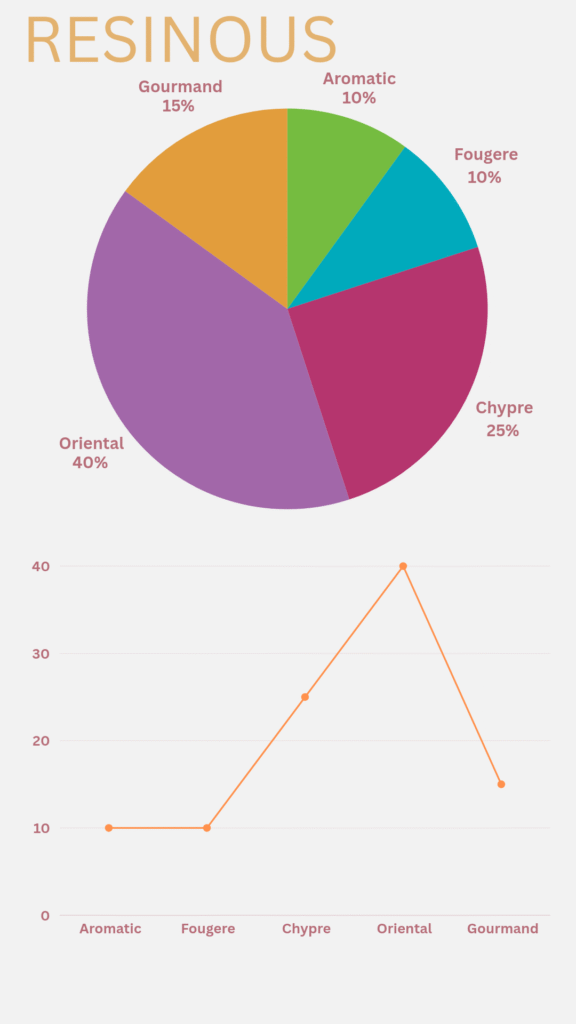
8. Resinous
Resin is a gummy substance secreted by trees—especially coniferous ones like pine and fir—as a defensive response to injury or cracking. The exuded liquid typically loses some of its more volatile components through evaporation, leaving behind a soft residue that is initially soluble but becomes insoluble over time.It is usually solid or semi-solid, with a dry or glassy texture, and is characterized by woody, smoky, or earthy aromas, such as: Olibanum (Frankincense), Myrrh, Elemi, Benzoin, Labdanum, and Opoponax.
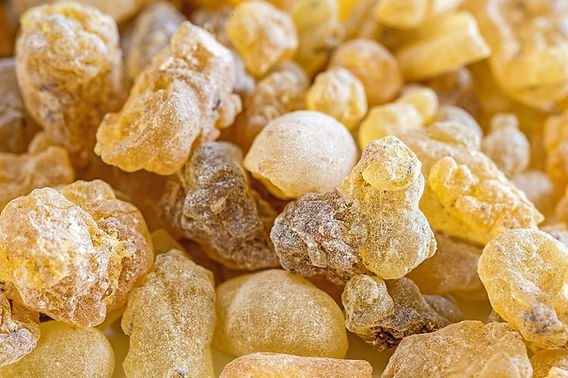
Olibanum
🌿 Botanical Source:
Boswellia sacra – A small tree from the Burseraceae family, primarily native to Oman, Yemen, Somalia, and Ethiopia. Frankincense is extracted by incising the bark and collecting the aromatic resin, which is then steam-distilled to obtain Frankincense Essential Oil.
🏷️ Aromatic Family Classification:
Resinous Oriental
📐 Olfactory Architecture:
Aromatic: 20%
Fougere: 15%
Chypre: 25%
Oriental: 35%
Gourmand: 5%
👃 Olfactory Scent:
Frankincense features a pure resinous scent with balsamic, acidic, slightly animalic, and warm medicinal nuances. It opens with fresh citrusy-camphoraceous top notes and evolves into a woody-balsamic heart, evoking a bright, spiritual depth.
Resinous – Acidic – Warm balsamic
Softly smoky (especially Somali frankincense)
Woody-ambery with a hint of lemon
Spiritual – Meditative – Sacred
Slightly fatty and warm
A clean trail reminiscent of temples and traditional incense
🗣️ “A luminous, citrusy-resinous, almost spiritual aroma with dry ambered depth and a delicate smoky thread — evocative of sacred rituals.”
Dry, diffusive, and bright citrus top notes over a deep, resinous / coniferous, slightly peppery and balsamic undertone. Eden
Warm, sweet balsamic, dry woody/resinous, very smooth, with a slightly peppery undertone and clear lemon and pine-like top notes. Eden
Fresh, warm, resinous, coniferous, with peppery undertones and a top note of lemon-orange citrus. Has a fresher, brighter Frankincense aroma than our Frankincense Co2 extracts. Eden
🧬 The Most Prominent Active Molecules in Frankincense Oil:
α-Pinene
Scent: Camphoraceous – Acidic – Fresh
Role: Opens the fragrance with a bright, cleansing temple-like freshness.
Incensole Acetate
Scent: Resinous – Balsamic – Luminous
Role: The key compound responsible for the meditative, spiritual character; documented to have psychoactive calming effects.
Limonene
Scent: Citrusy – Acidic
Role: Adds a bright, uplifting freshness to the top notes.
Octyl Acetate, p-Cymene
Scent: Fruity – Resinous – Earthy
Role: Contribute to frankincense’s complex, luxurious aroma profile.
⚙️ Structural Role:
Middle to Base Note
Frankincense serves as a pivotal component in:
Oriental – meditative perfumes
Resinous and incense-based compositions
Aromatic spiritual blends
Smoky leather and woody fragrances
🔸 It provides:
Deep balsamic-resinous warmth
Dry acidic-woody brightness
Spiritual calm and inner clarity
Excellent longevity without overwhelming
A seamless link between the top and heart notes
🎶 Olfactory Harmony:
Frankincense blends beautifully with:
Rose, Myrrh, Opoponax: To create a glowing, classic oriental base.
Sandalwood, Cedar, Oud: Enhances smoky-woody depth.
Citrus Notes (Lemon, Bergamot): Adds luminous freshness to the opening.
Spices (Cardamom, Nutmeg, Clove): Adds aromatic complexity.
Amber, Labdanum, Vanilla: Provides sweet, ambery softness.
Incense, Leather, Smoke Notes: Deepens spirituality and mystery.
🧪 Synthetic Analogs / Molecular Alternatives:
Cetalox / Ambroxan: To emulate the dry, warm trail of frankincense.
Fixolide: Adds longevity and a hidden silky layer.
Z11 (Ambergris analog): Introduces ambered-resinous depth when paired with frankincense.
Woody-Ambery Bases (e.g., Ambercore, Incensewood): Used to replicate luxurious frankincense profiles in modern perfumery.
📌 Final Notes:
Frankincense is one of the rare materials that balances purity and depth simultaneously.
It carries spiritual and cultural significance across ancient civilizations and religions, known for its calming effect on both mind and body.
Its active molecules fall into the terpenes family (monoterpenes + diterpenes), granting it a distinct and layered olfactory signature.
Its presence in a fragrance is like a “transparent backbone” — invisible yet essential to the fragrance’s structure.
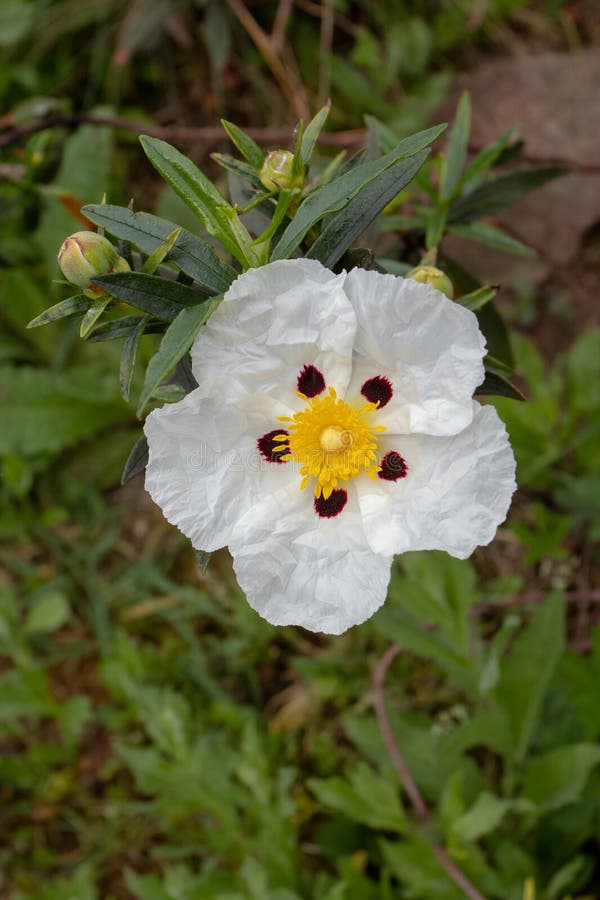
Labdanum
🌿 Botanical Source:
Cistus ladanifer is a Mediterranean shrub belonging to the Cistaceae family, native to countries like Spain, Portugal, and Morocco.
Labdanum is extracted from the sticky resin secreted by the leaves or through boiling the branches. It is typically processed into either a resinoid or absolute form.
🏷️ Aromatic Family Classification:
Resinous Oriental
📐 Olfactory Architecture:
Oriental: 40%
Chypre: 20%
Leather: 20%
Woody: 10%
Fougere: 10%
👃 Olfactory Scent:
Labdanum is a resinous material by botanical origin, but it performs a balsamic function olfactorily.
It is a resin with balsamic characteristics.
Balsamic, warm, honeyed, ambery, leathery.
Its scent is more balsamic than harshly resinous, often compared to dark honey or burnt caramel.
It can exhibit a dry edge when blended with mosses or dry woods.
Its softness comes from its balsamic and vegetal amber tone. Dryness is not an inherent trait but results from interaction with other materials like patchouli, oakmoss, or tobacco.
Powerful, deep, rich, sweet balsamic aroma with a faint herbaceous nuance and a persistent ambergris-like backnote; extremely tenacious. Eden
🧬 The Most Prominent Active Molecules in Labdanum:
Labdanoic Acid
Scent: Waxy, resinous, herbal, ambery
Role: Forms the backbone of labdanum’s deep resinous character
Ambroxide & Related Ambrenoids (e.g., Ambreine)
Scent: Warm amber, slightly animalic
Role: Contribute to the natural amber note, essential for oriental bases
Cinnamic Acid Derivatives
Scent: Warm, soft, balsamic
Role: Add sweetness and depth to the scent structure
Methyl Cinnamate & Methyl Jasmonate (in small amounts)
Scent: Balsamic – floral – fruity
Role: Impart soft floral harmony and gentle sweetness
Steroid-like Molecules (e.g., Cholestadiene)
Scent: Animalic – leathery
Role: Provide a smoky, rich leathery effect reminiscent of natural musk or tanned leather
⚙️ Structural Role:
Heart / Base Note
Labdanum is primarily used in the heart or base of a fragrance, delivering:
Warm amber depth
Dense resinous body
Majestic leather nuance
Mysterious animalic aura
It is a cornerstone material in:
Oriental perfumes
Chypre compositions
Leathery fragrances
Amber accords
Balsamic bases
🎶 Olfactory Harmony:
Labdanum blends particularly well with:
Tonka bean – for a warm, balsamic, gourmand base
Vanilla & Benzoin – to create a sweet, deep amber accord
Patchouli – essential for a classic chypre heart
Oud & Incense – for a rich, smoky oriental base
Leather accords – for a warmer, more refined leather profile
Cistus oil – to enhance the natural smoky profile
Musk & Castoreum – for complex animalic depth
Warm spices like cinnamon, clove, saffron – to balance the resinous warmth with spicy lift
Woods like sandalwood, cedar, and vetiver
Resins & balsams like opoponax, tolu, and myrrh
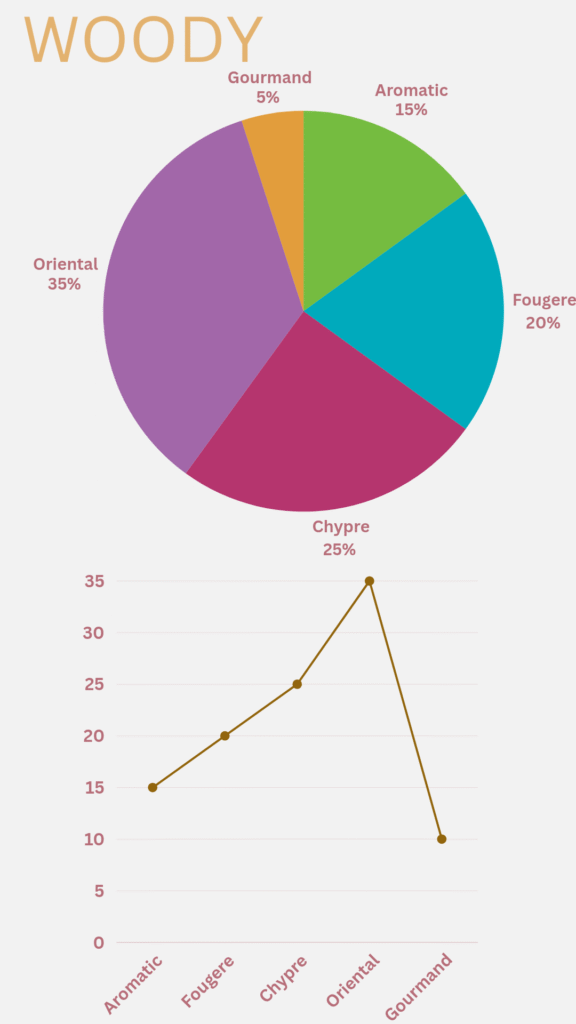
9. Woody
The Woody family is one of the most historic and profound fragrance families, representing the warm and majestic structural pillar of a perfume’s composition. It is renowned for its dry, earthy, or creamy character and is often used as the base note of a fragrance. This family evokes a sense of strength, longevity, and natural elegance, and it plays a vital role in many masculine, oriental, and modern woody creations.
Structural Role:
Commonly used in the base notes to provide longevity and depth.Acts as a fragrant backbone supporting florals, fruits, or spices.Sometimes featured in the heart notes to introduce an early dry or earthy tone.
Types of Woody Notes:
Soft woods like Sandalwood.
Dry woods like Cedarwood and Cypriol.
Smoky woods like smoky Patchouli and Guaiac wood.
Modern woods like Iso E Super.
Specific Examples:
Vetiver: Dry, earthy, smoky woody (Woody Aromatic).
Sandalwood: Creamy, soft woody (Woody Oriental).
Cypriol: Smoky, resinous, earthy woody (Woody Oriental).
Perfectly complements florals, spices, oriental, and amber accords.
Aromatic Examples:
Terre d’Hermès Hermès (2006), Jean-Claude Ellena.
Santal 33 Le Labo (2011), Frank Voelkl.
Wonderwood Comme des Garçons (2010), Antoine Lie.
Bois d’Ébène Matiere Premiere (2019), Aurélien Guichard.
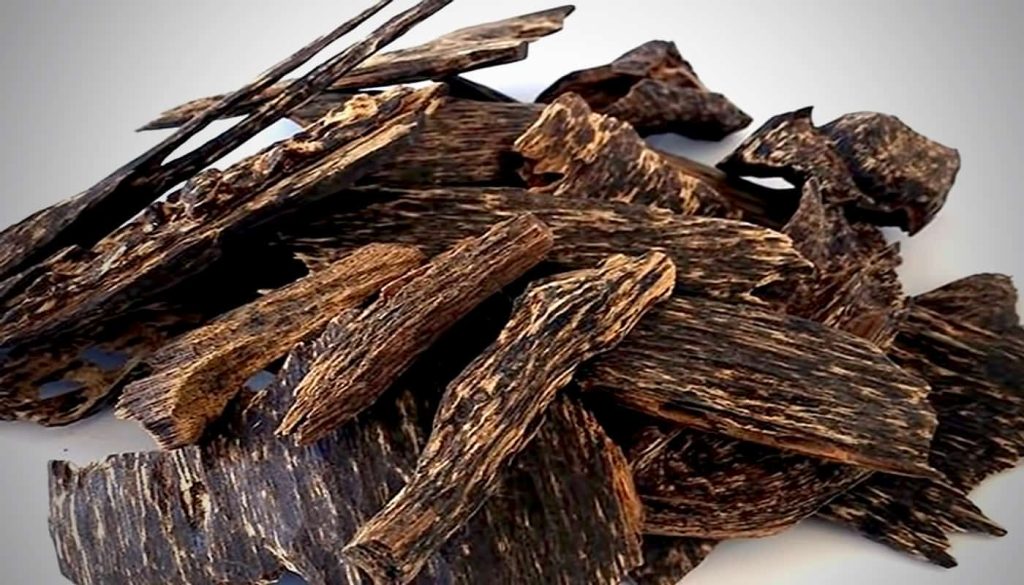
Agarwood
🌿 Botanical Source:
Aquilaria malaccensis (also: Aquilaria crassna, Aquilaria sinensis, among others) – a tropical tree from the Thymelaeaceae family, native to Southeast Asia: India, Vietnam, Cambodia, Laos, Thailand, Indonesia, and Malaysia.
Oud is formed when the tree is infected by a fungal pathogen (commonly Phialophora parasitica), triggering the production of a dense aromatic resin within the heartwood as a defense mechanism.
It is considered one of the rarest and most expensive raw materials in perfumery. Oud essential oil is extracted through hydro-distillation or steam distillation.
Resin is a natural exudate from the bark of trees in response to wounds, such as frankincense (Olibanum), myrrh (Myrrh), and benzoin (Benzoin).
Oud, however, is not a resinous exudate. Rather:
It is the result of the transformation of the wood itself (Aquilaria heartwood) into a dark, aromatic material due to fungal infection.
This means that the infected wood turns into a fragrant substance within its tissue—not as an external gum or sap.
Therefore: the aroma originates from the resin within the wood, not the wood alone.
Oud is a woody material, rich in resinous compounds, but it is not a resin in the classical sense.
While oud contains a high percentage of resinous molecules (like sesquiterpenes, oudene, and guaienes), referring to it as “resinous” is a description of its scent, not its classification.
Oud is neither purely woody (like cedarwood or sandalwood),
nor purely resinous (like frankincense or myrrh).
Thus: Oud is a modified woody substance, not a gum resin.
> “The scent of oud is where burnt wood meets temple smoke, with a touch of raw leather and warm balsam. Depending on its source and presentation, it can smell floral, leathery, or even wildly animalic”.
🏷️ Aromatic Family Classification:
Woody Oriental
📐 Olfactory Architecture:
Aromatic 5%
Fougere 10%
Chypre 25%
Oriental 55%
Gourmand 5%
👃 Olfactory Scent:
The scent of oud is highly complex and multilayered. It varies by origin and processing, but its general olfactory character can be described as:
Deep woody
Mysteriously smoky
Dark balsamic
Lightly animalic/leathery
Sweet resinous richness
Earthy and mossy touches
Occasionally with a burnt or medicinal edge
> “A rich, complex, dark and resinous aroma, balancing smoky wood, soft leather, and a balsamic sweetness with long-lasting mystique.” — Ensar Oud
> “Highly persistent, sweet, warm, deeply complex, precious woody aroma with shades of smoky, ambery incense, honeyed tobacco, and sensual animalic notes resembling musk or castoreum.” — Eden Botanicals
🧬 The Most Prominent Active Molecules in Natural Oud Oil:
Agarospirol
Scent: Resinous – balsamic – soft
Role: Provides oud’s refined, signature balsamic softness and luxurious profile.
Jinkoh-eremol
Scent: Woody – mysterious – deep
Role: Enhances the dark, smoky quality; considered one of the hallmark compounds of high-grade oud.
Eudesmol Isomers (α, β, γ)
Scent: Earthy – resinous – slightly animalic
Role: Adds longevity and dry depth, bridging woodiness with smoky tones.
Selinenes & Guaianes
Scent: Resinous – aromatic – smoky
Role: Create a complex balance of smoke, warmth, and sharp, burning-wood nuances.
⚙️ Structural Role:
Base Note – Oud is used as a foundational base material due to its strength, persistence, and olfactory depth.
It contributes:
A luxurious oriental signature
Long-lasting fixation
Complex aromatic architecture
An ideal base for blending with animalic and resinous notes
Commonly used in:
High-end niche fragrances
Oriental and oudy compositions
Smoky, mysterious perfumes
Dark chypre and fougère structures
🎶 Olfactory Harmony:
Rose, Ta’if, Jasmine, Orange Blossom:
Highlights the contrast between clean florals and smoky oud.
Amber, Labdanum, Benzoin:
Builds a warm, balsamic oriental base.
Leather, Civet, Castoreum:
Accentuates the dark, animalic and leathery facets.
Frankincense, Myrrh, Incense:
Evokes a spiritual, incense-filled ambiance.
Saffron, Cardamom, Nutmeg:
Adds refined Eastern spice and warmth.
Vanilla, Tonka Bean:
Softens the darkness with a subtle gourmand sweetness.
🧪 Synthetic Analogs / Modern Alternatives:
Due to the scarcity and high cost of natural oud, several synthetic materials are used to imitate its effect:
Cypriol / Nagarmotha Oil:
A plant-derived oil used to replicate oud’s smoky-leathery tone.
Isobutyl Quinoline:
Adds a dark, leathery note reminiscent of oud.
Oudh Synth, Oudhex, Oudmethyl:
Contemporary synthetic molecules used in designer fragrances to mimic oud affordably.
Z11 (Trisamber):
A powerful fixative with a dry, smoky-woody impression similar to synthetic oud.
📌 Final Notes:
Oud’s aroma is based on a complex nonpolar molecular structure, making it highly skin-affine and extremely long-lasting.
Natural oud is a prime example of a raw material that is extremely difficult to replicate accurately via synthesis. The true experience depends on rare sourcing and artisanal distillation.
Its spiritual and emotional depth has made oud a cultural and aromatic icon throughout the Arab and Asian worlds.
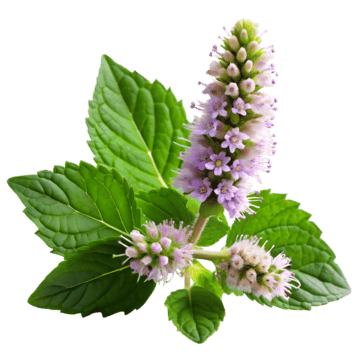
Patchouli
🌿 Botanical Source:
Pogostemon cablin – A dense herbaceous plant from the Lamiaceae (mint) family.
Thrives in humid tropical climates and is primarily cultivated in Indonesia, India, the Philippines, and Sri Lanka.
Its leaves are harvested, dried, and stored for fermentation before the aromatic patchouli essential oil is extracted via steam distillation.
It is considered one of the heaviest and most mysterious essential oils, playing a major role in building oriental and chypre fragrance bases.
🏷️ Aromatic Family Classification:
Woody Oriental Chypre
📐 Olfactory Architecture:
Patchouli clearly resides within the Chypre and Oriental fragrance worlds in terms of perfumery use.
Chypre 40%
Oriental 30%
Fougere 15%
Aromatic 10%
Gourmand 5%
👃 Olfactory Scent:
Patchouli is among the clearest raw materials that express a blend of dry, deep woody character and moist, dusty-earthy tones, making it a core element in this sub-family.
In some compositions, patchouli may present light balsamic or even herbal undertones, but these are not its defining identity.
Its scent fuses damp earth, dark woods, and rich, dried green nuances. Depending on the distillation method, patchouli can transform into a warm oriental base, a strict chypre foundation, or even an earthy gourmand twist.
When the oil is fresh or unaged, it contains a slight camphoraceous freshness, enhancing the greenish aspect.
Upon aging, its woody depth becomes more prominent.
Patchouli requires fermentation of its leaves before distillation. This process transforms the fresh green compounds into deeper, heavier, and earthier molecules. So although the leaves are originally green, the final oil is not.
For this reason, patchouli is not classified as “green”, since its molecular spectrum leans heavily toward earthy, woody, and balsamic notes rather than fresh leafy ones.
Any greenness it may convey is dark, damp, reminiscent of mud or decomposing vegetation, not the bright, crisp greenness typical of classic green perfumes.
The scent of patchouli is deep, earthy, dark, and complex, combining:
Earthy – Balsamic – Moldy Herbal
Dark Woody
Damp Soil-like Notes
Smoky Leathery Touch
Subtle Hidden Sweetness
It is sometimes described as the smell of “wet, decomposing leaves” or an “ancient Eastern temple.”
“Extremely rich, deep, earthy, sweet-herbaceous, somewhat spicy aroma, with ethereal, floral-sweet and wine-like top notes and a mellow, woody-balsamic body note. Known as one of the finest fixatives with outstanding tenacity.”
— Eden Botanicals
🧬 The Most Prominent Active Molecules in Patchouli Oil:
Patchoulol (Patchouli Alcohol)
Scent: Earthy – Woody – Moist
Role: The primary molecule responsible for patchouli’s dense, tenacious scent.
α-Bulnesene & α-Guaiene
Scent: Smoky – Earthy – Dark
Role: Add rooty depth and reinforce the woody base.
Pogostol
Scent: Soft Balsamic
Role: Contributes a gentle amber-like softness to the base.
Norpatchoulenol
Scent: Fresh – Slightly Green
Role: Lightens the density of patchouli and gives a dynamic balance.
⚙️ Structural Role:
Base Note
Patchouli is used primarily in the base of perfumes to impart:
Complex Earthiness
Dark Woodiness
Attractive Smokiness
Warm Leathery Touch
Luxurious Oriental-Chypre Depth
Long-lasting Fixation and Rich Drydown on Skin
🎶 Olfactory Harmony:
Patchouli harmonizes beautifully with:
Amber, Labdanum, Benzoin: To strengthen warm amber bases.
Cedarwood, Vetiver, Sandalwood: For layered, interwoven woody depth.
Rose, Geranium, Iris: For a luxurious floral-earthy balance.
Vanilla, Tonka Bean, Cocoa: To enhance gourmand and sensual qualities.
Citrus Notes (Bergamot, Orange): To cut through the earthy density and offer bright top freshness.
Oud, Leather, Incense: To amplify the smoky, mysterious dimension.
Spices (Clove, Cinnamon, Cardamom): For a warm, opulent oriental breath.
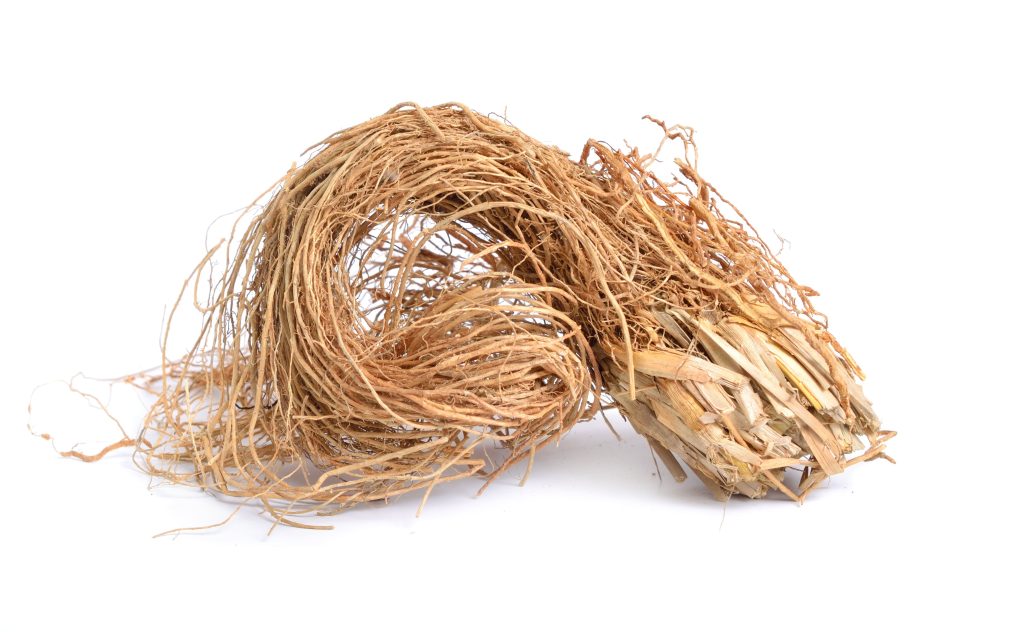
Vetiver
🌿 Botanical Source:
Vetiveria zizanioides – A perennial grass from the Poaceae family. It grows naturally in tropical regions such as India, Haiti, Indonesia, and Madagascar. The essential oil is extracted from the plant’s roots through steam distillation. It is considered one of the most important base materials in perfumery, especially in woody and ambery compositions.
🏷️ Aromatic Family Classification: Woody Oriental
📐 Olfactory Architecture:
Aromatic: 10%
Fougere: 20%
Chypre: 25%
Oriental: 40%
Gourmand: 5%
👃 Olfactory Scent:
Vetiver is known for its deep, earthy, and smoky woody scent with dry herbal and balsamic nuances.
Earthy – Rooty – Deep
Woody – Smoky
Dry herbal
Light balsamic warmth
Slightly spicy with a subtle leathery tone
It is often described as the scent of “earth after rain,” giving it a raw and pure character.
Vetiver is both grounding and mysterious — the scent of ancient earth and smoky roots.
Deep, heavy, slightly sweet and resinous, with pronounced woody, earthy, root-like notes and light smoky undertones — an outstanding base note with similar depth to double-distilled vetiver. (Eden)
🧬 The Most Prominent Active Molecules in Vetiver Oil:
Khusimol
Scent: Woody – Earthy – Warm
Role: The main component responsible for vetiver’s signature earthy depth.
Vetiselinenol
Scent: Soft woody – Balsamic
Role: Adds smoothness and long-lasting softness to the drydown.
α-Vetivone & β-Vetivone
Scent: Dry – Rooty – Slightly Spicy
Role: Create the characteristic smoky-earthy depth of vetiver.
Isovalencenol
Scent: Earthy – Aromatic
Role: Brings a lively and natural freshness to the woody structure.
⚙️ Structural Role: Base Note Vetiver is primarily used in the base of perfumes to deliver:
Smoky earthiness
Deep rooty intensity
Warm woody dryness
Masculine depth
Exceptional longevity and drydown character
It is a foundational material in:
Dry Orientals
Woody-Leathery fragrances
Classic Chypres
Complex Fougères
🎶 Olfactory Harmony: Vetiver harmonizes beautifully with:
Cedarwood & Sandalwood: For enhancing warm woody tones
Patchouli: To intensify the rich earthy-chypre effect
Tonka Bean & Vanilla: For softening the dryness with a gourmand touch
Benzoin & Labdanum: To deepen the balsamic-ambery base
Citrus Top Notes (e.g., Bergamot, Grapefruit): To brighten and lift the heaviness
Oud & Leather Accords: To build a smoky, leathery oriental foundation
Incense & Myrrh: For a spiritual or ceremonial dimension
Spices like Black Pepper & Nutmeg: To boost the spicy, complex layers
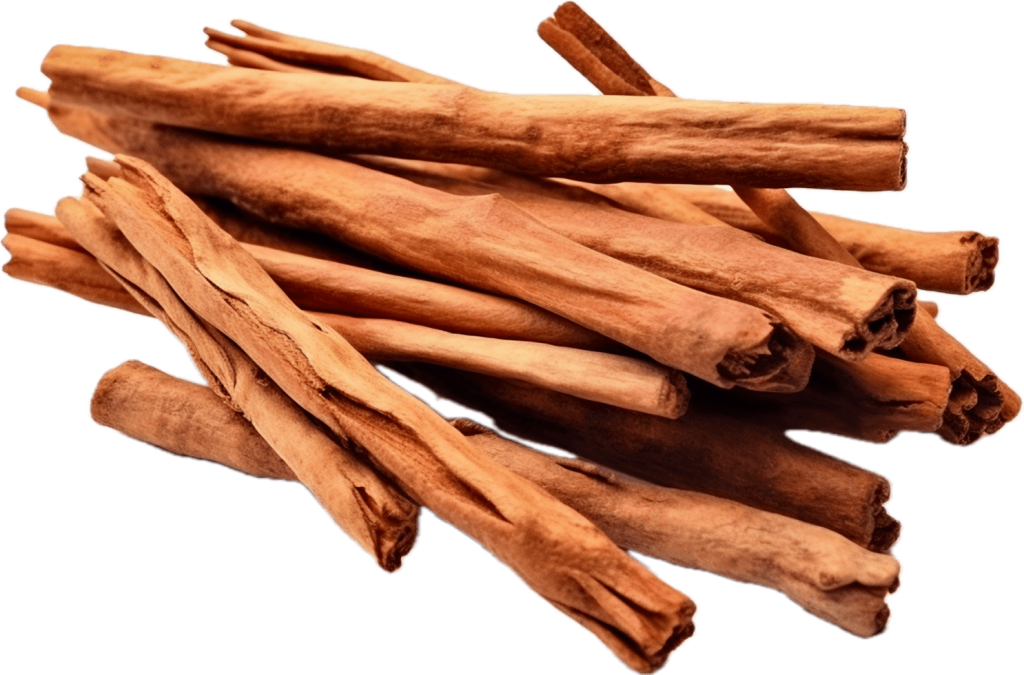
Sandalwood
🌿 Botanical Source:
Santalum album – an evergreen tree from the Santalaceae family.Native to India (especially Mysore and southern regions), it is also cultivated in Australia, Sri Lanka, and Indonesia.
The essential oil is extracted from the heartwood of mature trees (typically 15–30 years old) and is considered one of the most luxurious and refined aromatic oils in the world, obtained through steam distillation.
🏷️ Aromatic Family Classification:Woody Oriental
📐 Olfactory Architecture:
Aromatic: 10%
Fougere: 20%
Chypre: 15%
Oriental: 50%
Gourmand: 5%
👃 Olfactory Scent:
Sandalwood is characterized by a soft, creamy, warm woody aroma, with balsamic and velvety undertones, accompanied by a powdery, silky feel and hints of sweetness.
Warm woody
Creamy and silky
Subtle balsamic
Powdery smooth
Faint sweet tone
Slight nuance of coconut or milkIt evokes feelings of serenity, warmth, and meditation, and has traditionally been used in spiritual rituals due to its calming effect.
“Very rich, sweet, exceptionally smooth, creamy, precious wood aroma, with warm fresh undertones; displays good tenacity in the dry down.” — Eden Botanicals
🧬 The Most Prominent Active Molecules in Sandalwood Oil:
α-Santalol
Scent: Creamy – Woody – Warm
Role: The primary molecule responsible for the creamy smoothness and deep warmth of sandalwood.
β-Santalol
Scent: Soft – Powdery – Woody
Role: Enhances the powdery drydown and velvety texture.
Santalenes (α & β)
Scent: Woody – Earthy – Balsamic
Role: Add balance between woody depth and a slightly herbal tone.
⚙️ Structural Role:
Base Note
Sandalwood is primarily used in the base of a fragrance to impart:
Warm, creamy woody foundationSmooth powdery textureLong-lasting fixative quality
Soft radiance and meditative depth
Balance with sharp or bold top/middle notes
It is a staple in:
High-end Oriental fragrances
Elegant Fougere compositions
Soothing, contemplative perfumes
Powdery, balsamic, and soft woody blends
🎶 Olfactory Harmony:
Sandalwood blends harmoniously with:
Rose, Jasmine, Iris – for warm powdery floral bouquets
Vanilla, Tonka Bean, Benzoin – to enhance the sweet creamy dimension
Cedarwood, Vetiver, Patchouli – for a rich, structured woody base
Amber, Labdanum, Myrrh – to deepen the balsamic-amber accord
Oud, Incense, Leather – for a soft, smoky oriental-leather base
Spices (Cardamom, Saffron) – to add warm, complex Eastern nuance
Citrus Notes (Lemon, Bergamot) – for a refined bright opening contrast
🧪 Synthetic Analogs / Modern Substitutes:
Due to its rarity and high cost, natural sandalwood is often replaced or supported by synthetic alternatives, including:
Ebanol – very stable synthetic with a sandalwood-like scent
Polysantol – delivers a milky, creamy sandalwood feel
Javanol – modern, powerful molecule with a luminous, creamy sandalwood character
Sandela, Bacdanol, Sandalore – popular sandalwood substitutes in modern perfumery
📌 Final Notes:
What distinguishes sandalwood is its low polarity, making it highly skin-friendly, stable, and deeply grounding in fragrance compositions.
Natural compounds like α-santalol and β-santalol belong to the sesquiterpenol class, known for their soothing and fixative properties in perfumery.
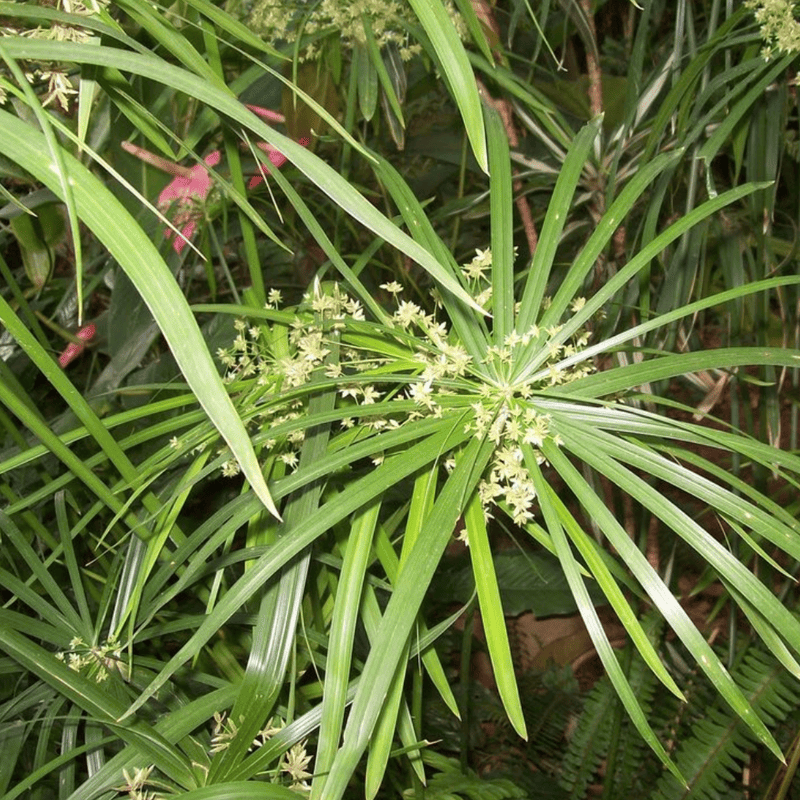
Cypriol (Nagarmotha)
🌿 Botanical Source:
Cyperus scariosus – a perennial herbaceous plant from the Cyperaceae family. It grows wild across South Asia, especially in India. The essential oil is extracted through steam distillation of the roots, and its scent comes from a rich blend of sesquiterpenes and smoky, earthy molecules.
🏷️ Aromatic Family Classification:Woody Oriental
📐 Olfactory Architecture:
Oriental 40%
Chypre 35%
Aromatic 15%
Fougere 10%
Gourmand <5%
👃 Olfactory Scent:
Cypriol is known for its dry, earthy smokiness—reminiscent of leather, oud, and moss.Main notes:SmokyHerbal–EarthyDark – DrySlightly BalsamicReminiscent of burnt roots, oud, or leatherUsed to build rich, mysterious bases in oriental, amber, and sensual fragrances.
“Rich, persistent, woody, earthy, deep, and somewhat peppery aroma with smoky leather-like nuances; reveals sweet-woody undertones and a consistent scent profile through the drydown.” — Eden Botanicals
🧬 The Most Prominent Active Molecules in Cypriol Oil:
α-Cyperone
Scent: Woody, herbal, earthy
Role: Primary source of the smoky-earthy aroma
Cyperene
Scent: Smoky, dry, resinous
Role: Adds density and a distinct masculine identity
Patchoulene-like Sesquiterpenes
Scent: Earthy, patchouli-like
Role: Deepens the rooty, grounded character
Caryophyllene (in certain samples)
Scent: Spicy, dry
Role: Enhances sharpness and dry spice facets
⚙️ Structural Role:
Base Note Cypriol is typically used in the base of perfumes to add:
Smoky-earthy depth
Dark leathery texture
Rooty ruggedness
Dry oriental warmth
Dense and long-lasting sillageIt’s a cornerstone in fragrances such as:
Dry Orientals
Smoky Leather compositions
Synthetic Oud blends
Bold masculine niche perfumes
🎶 Olfactory Harmony:
Cypriol blends especially well with:
Oud: for building smoky, mysterious oriental bases
Patchouli: to enhance the chypre-earthy structureLabdanum & Myrrh: for warm, resinous complexity
Cedarwood & Sandalwood: to soften the harshness and add structure
Saffron & Cistus: for a rich, luxurious leather effect
Incense & Smoke notes: to reinforce its smoky identity
Musk & Vetiver: for a soft, earthy-animalic base
Tonka & Benzoin: to round out the blend with smooth balsamic warmth
Oud is wood infected by a type of fungal infection (typically Phialophora parasitica) that affects the Aquilaria or Gyrinops trees. In response, these trees secrete aromatic defensive substances (resin) that accumulate within the wood tissue.
Resin is a natural secretion from the bark of trees, produced as a response to wounds. Examples include olibanum (frankincense), myrrh, and benzoin.
Oud, however, is not a resinous secretion. It is:
The result of the transformation of the wood itself (the wood of the Aquilaria tree) into a dark, aromatic material due to fungal infection.
In other words, the infected wood turns into an aromatic substance within the wood tissue, not as an external resin or sap.
Thus, the scent comes from the resin within the wood—not from the wood alone.
Oud is a woody material rich in resinous compounds, but it is not a resin in itself.
Oud contains a high concentration of resinous molecules (such as sesquiterpenes, oudhines, and gyrin), which is why it is sometimes described as “resinous.” However, this is a description of the olfactory character, not its material classification.
Oud is neither purely woody (like cedarwood or sandalwood), nor purely resinous (like frankincense or myrrh).
Therefore, oud is a modified woody material, not a resin.
The scent of oud is an encounter between scorched wood, the smoke of Eastern temples, a hint of raw leather, and warm balsam. It can appear aromatic, leathery, or even wildly animalic—depending on its origin and how it is rendered.
Olfactive Architecture:
55% Oriental family
25% Chypre
10% Fougère
5% Aromatic
5% Gourmand
Aromatic Classification: Woody Oriental.
Character: Woody, balsamic, smoky, animalic, resinous, Oriental.
Structural Role – Used in:
. Oriental perfumes: as a key element that gives the fragrance a warm and mysterious character.
. Leather-style accords: sometimes used to build the smoky, animalic facets of leather.
. Luxurious resinous or amber-based perfumes.
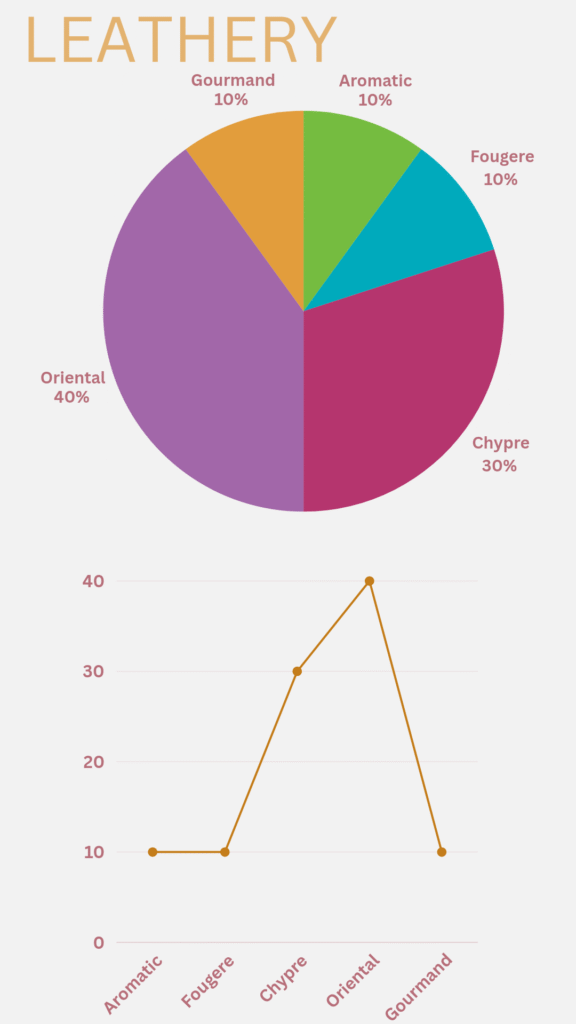
10. Leathery
It is true that “leather” is not a single raw material or a natural ingredient in the traditional sense, but rather a synthetic accord built from a blend of materials such as Isobutyl Quinoline, Birch Tar, Castoreum, Labdanum, Saffron, and others. Nevertheless, “leather” is classified as an olfactive family for logical reasons:
1. A distinct and stable olfactory identity:
Although the scent of leather is created from a blend of materials, the final result produces a unique and recognizable olfactory identity that is easy to identify in perfumes—much like what happens with aldehydes.
2. Industry and societal acceptance:
The leather family has become widely accepted and recognized by major references and many perfume schools as an independent olfactive family, because it conveys a specific scent profile often associated with luxury, rebellion, or dark elegance.
3. Consistency and recurrence in use:
Dozens—if not hundreds—of perfumes are built around this kind of structure, making it a cohesive and standalone olfactive current in terms of sensory impact and aesthetic experience, regardless of how it is constructed.
Leather is considered one of the most complex sub-families in the world of perfumery. Its scent is rarely extracted from real leather; instead, it is usually recreated through the use of aromatic chemicals that mimic the smell of tanned leather, burnt leather, or even luxurious leathers (like leather shoes or handbags).
Leather fragrances tend to lean toward the Oriental and Chypre families.
They are typically built through specific accords, composed by blending materials such as:
Isobutyl quinoline
Pyralone
Suederal
Birch tar
Cade oil
Styrax
Labdanum
Tobacco
Safraleine
Aromatic Examples:
Tabac Blond by Caron (1919), Ernest Daltroff
Knize Ten by Knize (1920), Vincent Roubert and François Coty
Cuir de Russie (Les Exclusifs de Chanel)..(1924), Chanel, Ernest Beaux
Tuscan Leather by Tom Ford (2007)
Irish Leather by Memo Paris (2013), Aliénor Massenet
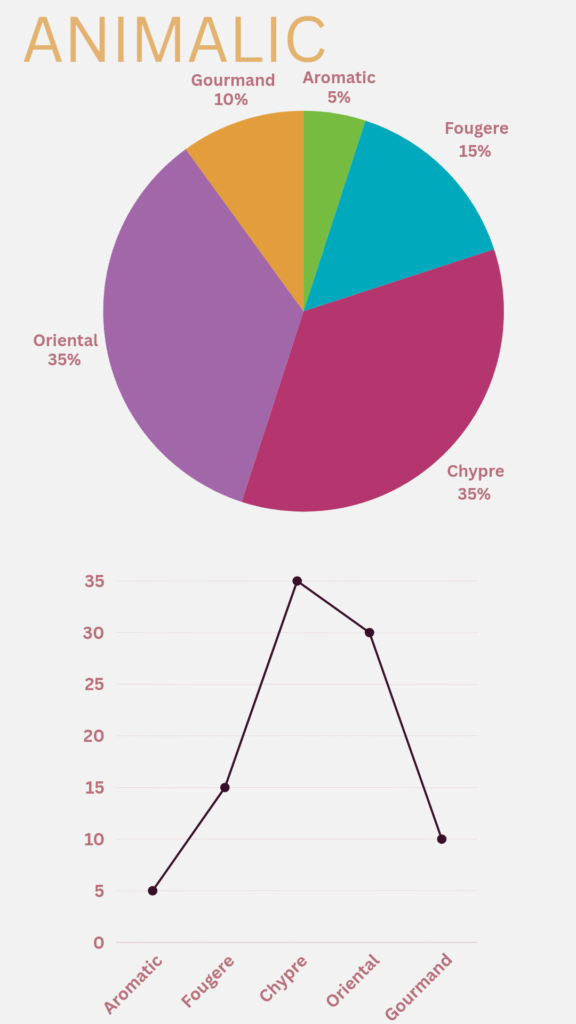
11. Animalic
A perfume is referred to as “animalic” when it features notes derived from raw materials of animal origin, such as civet, castoreum, ambergris, or deer musk. It may also include raw materials of plant or synthetic origin—such as certain types of white musks, oud, costus, or white flowers like jasmine and orange blossom—which also contribute furry or wild facets to the composition. These animalic nuances are often found in amber or oriental fragrances.
Animalic, leathery, sensual, intense, inky, warm, ammoniacal, musky, diffusive, and long-lasting.
Highly valued for their ability to add warm depth, strength, and sensuality to a fragrance, animalic notes are essential to the history of perfumery.
These powerful, sensual, and diffusive notes create a captivating and persistent effect, acting as a kind of fixative. They hold a distinguished place in fragrance compositions due to their capacity to enhance softness and enriched depth.
For various environmental reasons, natural animalic notes have largely been replaced today by synthetic molecules that skillfully recreate those warm and sensual effects.
Whether recreated with natural or synthetic ingredients, these raw materials are often unpleasant in their
pure form, yet they contribute depth, complexity, and a mysterious allure to perfumes.
Examples of animalic materials:
Musc deer
Civet
Castoreum
Costus
Beeswax
Indole
Skatole
Ambergris
Oud
Note: Natural materials aren’t exclusively animal-derived—some can be plant-based yet have distinctly animalic odors.
Aromatic Examples:
Kouros by Yves Saint Laurent (1981), Pierre Bourdon
Muscs Koublai Khan by Serge Lutens (1989), Christopher Sheldrake
Hyrax by Zoologist Perfumes (2018), Sven Pritzkoleit
Oudh Infini by Parfums Dusita (2016), Pissara Umavijani
Ma Bête by Eris Parfums (2016), Antoine Lie
These ten sub-families contribute in varying proportions to the formation of olfactive architecture of the five main fragrance families.
Please note that fragrance classification can sometimes be subjective, and certain perfumes may be categorized under more than one family due to the complexity of their compositions.
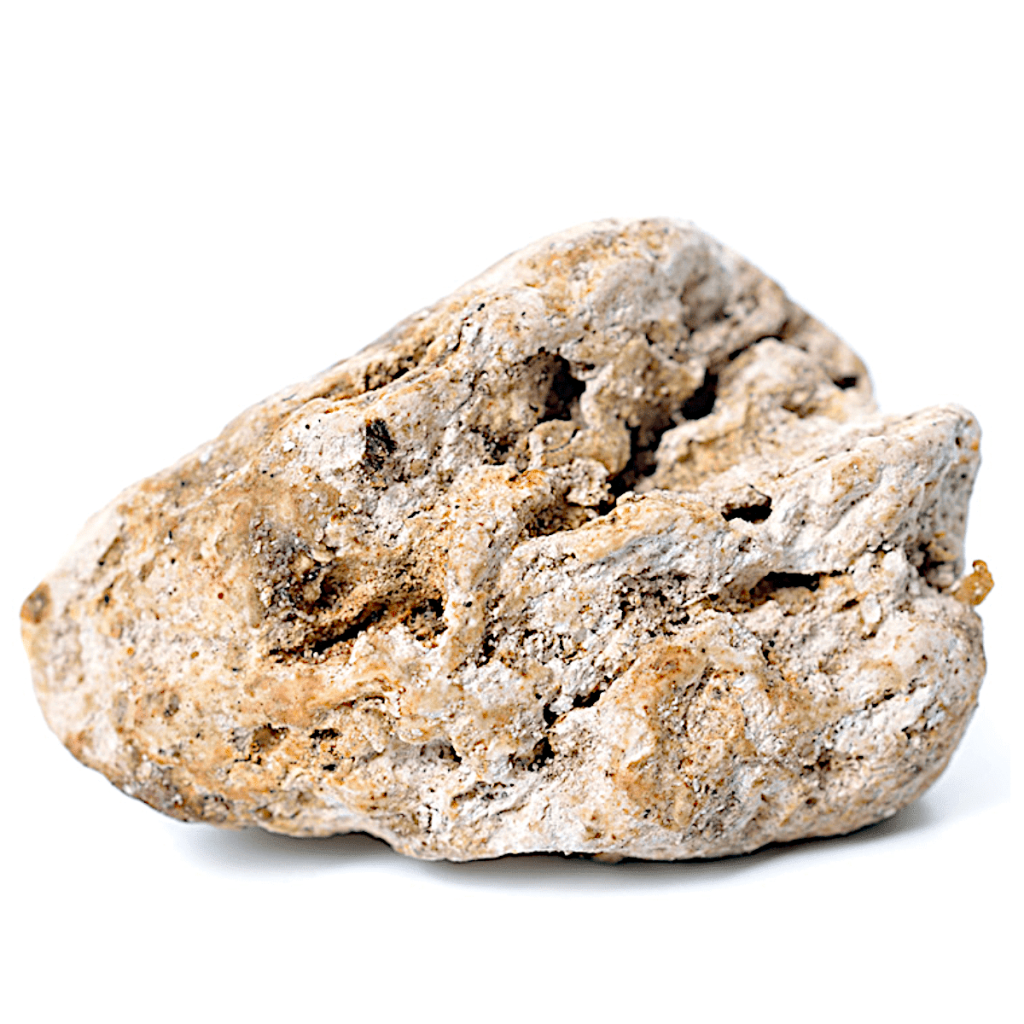
🦈 Animalic Source:
Ambergris is a rare waxy substance formed inside the intestines of the sperm whale (Physeter macrocephalus) as a reaction to hard, indigestible materials such as squid beaks.
This material is expelled into the sea, where it undergoes years of exposure to water, salt, and sunlight, transforming into a luxurious substance with a mysterious and unique scent.
Natural ambergris is collected from shorelines or directly from the ocean, and is considered one of the most expensive and rare animal-derived aromatic materials in the world.
🏷️ Aromatic Family Classification:
Animalic Oriental
📐 Olfactory Architecture:
Aromatic: 15%
Fougere: 10%
Chypre: 25%
Oriental: 40%
Gourmand: 10%
👃 Olfactory Scent:
Aged natural ambergris is characterized by a scent that is:
Ambery – Warm – SoftPowdery – Clean – Ethereal
Marine – Salty – Earthy
Lightly Animalic (but refined and non-aggressive)
Smoky – Leathery – Sweet undertone
> “Ambergris has a smooth, musky, warm, sweet, animalic scent with marine and tobacco-like nuances.
It adds radiance, diffusion, and longevity to perfumes like no other ingredient.” — Perfumer’s Apprentice
🧬 The Most Prominent Active Molecules in Ambergris:
Ambreine
Scent: Sweet – Balsamic – Warm – Powdery
Role: The key natural compound responsible for ambergris’ sensual, ambery character. It enhances fixative power and deep warmth.
Ambroxide (Ambroxan)
Scent: Ambery – Woody – Skin-like
Role: A derivative of natural ambergris, widely used today for its radiant, long-lasting, clean ambery effect.
Macrocyclic Ketones & Amberolides
Scent: Musky – Marine – Animalic
Role: Add a refined animalic tone and marine-leathery depth, improving diffusion and persistence.
⚙️ Structural Role:
Base Note – Ambergris is used at the base of perfumes to provide:Long-lasting tenacity and inner warmthRadiant yet soft olfactory aura
A unique marine-leathery texture
A skin-like, ambery, musky identity
A subtle animalic nuance that enriches depth and harmony
📌 Commonly Used In:
Mysterious and luxurious oriental compositionsLeather and balsamic fragrances
Natural marine-inspired perfumes
Niche, complex, and deeply warm perfumery blends
🎶 Olfactory Harmony:
Ambergris blends beautifully with:
Musk, Civet, Castoreum: To build elegant animalic bases
Sandalwood, Cedarwood, Oud: For a deep, warm, woody foundation
Rose, Jasmine, Ylang-Ylang: To balance animalic tones with floral softness
Vanilla, Tonka, Benzoin: To enhance sweet, balsamic warmth
Incense, Labdanum, Myrrh: To deepen the smoky, ambery aspect
Spices (Cinnamon, Nutmeg, Clove): For an exotic, oriental touch
Aldehydes or Citrus (Bergamot, Lemon): To brighten and lift the opening
🧪 Synthetic Analogs / Replacements:
Due to the rarity and high cost of natural ambergris, modern perfumery often uses synthetic alternatives:
Ambroxan: The most widely used replacement; radiant, warm, and persistent
Cetalox: Clean, ambery-marine molecule, featured in perfumes like Not a Perfume
Ambrinol, Ambermax, Ambercore: Contemporary synthetics with glowing, leathery-ambery profiles
Grisalva, Orcanox: New-generation alternatives offering clean, marine-powdery nuances
📌 Closing Notes:
Ambergris is renowned for its high olfactive modulation — the ability to smooth, unify, and elevate other ingredients without dominating them.
It is one of the best natural fixatives, always associated with warmth, mystery, and sensuality.
Musk
🌿 Botanical/Animalic Source:
Musk – Traditionally, natural musk was extracted from the gland of the male musk deer (Moschus moschiferus), native to Central Asia. However, this practice has been globally banned due to environmental laws and animal protection regulations.
Today, synthetic musk is exclusively used in perfumery—especially white musks—which are classified into different molecular families such as: Nitro musks, Polycyclic musks, Macrocyclic musks, and Alicyclic musks.
🏷️ Aromatic Family Classification:
Animalic Oriental
📐 Olfactory Architecture:
Aromatic: 10%
Fougere: 10%
Chypre: 25%
Oriental: 40%
Gourmand: 15%
👃 Olfactory Scent:
Musk’s scent profile ranges from light and soft to deep and animalic. Key nuances include:
Soft Powdery Floral
Clean Cottony Freshness
Mild Animalic Leatheriness
Warm Silky Texture
Skin-like Sensuality
Subtle Sweetness
Musk evokes sensations of purity, intimacy, calmness, and elegance, often described as “a scent that isn’t smelled but felt.”
> “Subtle, powdery, sensual, and long-lasting. It doesn’t shout — it whispers.” — IFF
🧬 The Most Prominent Synthetic Musk Molecules:
💠 Galaxolide
Scent: Clean – Powdery – Floral
Type: Polycyclic Musk
Role: Widely used for its fresh, clean character and strong longevity.
💠 Habanolide
Scent: Soapy – Floral – Radiant
Type: Macrocyclic Musk
Role: Adds brightness, powdery elegance, and soft leathery nuance.
💠 Musk Ketone (currently restricted in some countries)
Scent: Dense – Powdery – Floral
Type: Nitro Musk
Role: Formerly used to enhance the richness and depth of natural musk profiles.
💠 Helvetolide
Scent: Fruity – Musky – Clean
Type: Alicyclic Musk
Role: Adds a fresh, fruity brightness to musky compositions.
⚙️ Structural Role:
Base Note
Musk is typically used in the base of a fragrance to perform the following functions:
Reinforcing longevity and fixation on the skin
Acting as a binder across top, heart, and base
Providing a soft, powdery, clean finish
Creating a “second skin” aura
Adding elegance, smoothness, and comfort without dominance
🎶 Olfactory Harmony:
Musk blends beautifully with:
Soft Florals (Rose, Peony, Violet): To enhance the intimate, powdery bouquet.
Powdery Bases (Iris, Tonka, Vanilla): To enrich the creamy, milky dimension.
Light Woods (Cashmeran, Cedar): For warm structure and subtle leathery texture.
Clean Accords (Aldehydes, Citrus): To boost freshness and purity.
Amber Accents (Ambrette, Ambrox): For a sensual, musky-amber undertone.
🧪 Natural or Botanical Alternatives to Animalic Musk:
🌱 Ambrette Seed (Abelmoschus moschatus)
Botanical Musk: Oil is extracted from the seeds, offering a musky, floral, and slightly fruity aroma.
Scent Profile: Powdery – Warm – Fruity – Musky
Used as a luxurious natural alternative to animal musk in fine and natural perfumery.
📌 Closing Notes:
Synthetic musk molecules are generally non-polar, making them highly stable and skin-adherent, with slow and continuous release.
Musk is one of the most widely used aroma chemicals in the world, found in over 90% of commercial fragrances.
Musk is not just a smell — it’s a sensation, enhancing warmth, softness, and purity.
In luxury perfumery, musk is often a subtle yet profound signature, anchoring the fragrance in elegance and intimacy.
Accords:
Gourmand Accords
1. Powdery accord
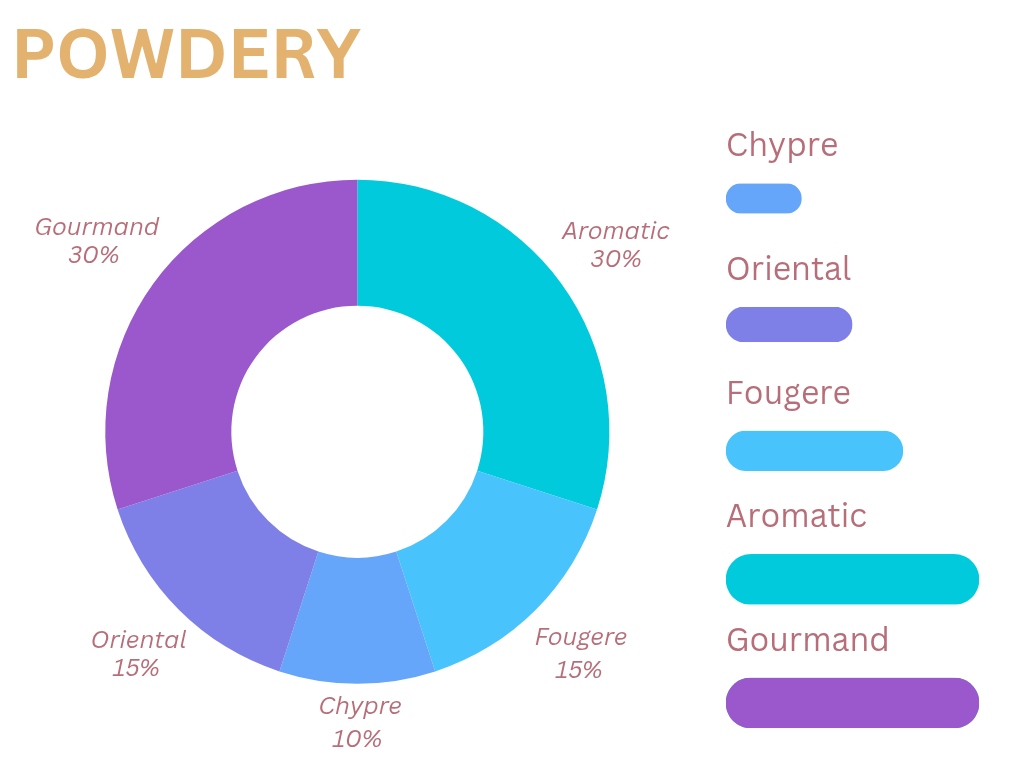
2. Creamy Accord
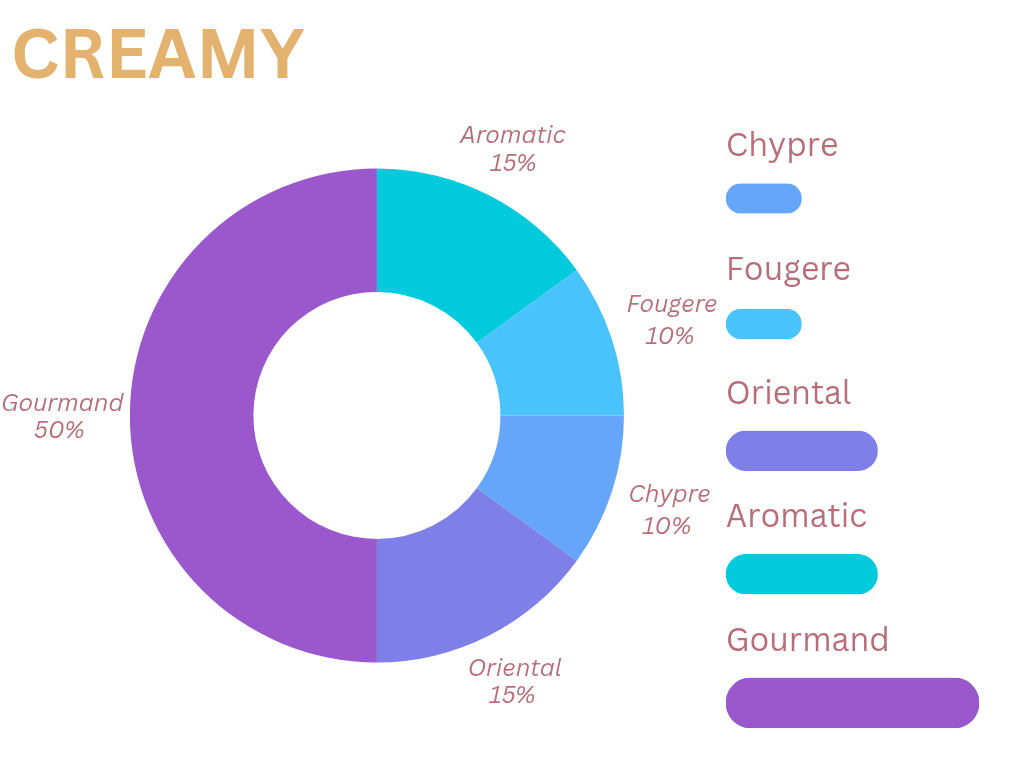
3. Lactonic Accord
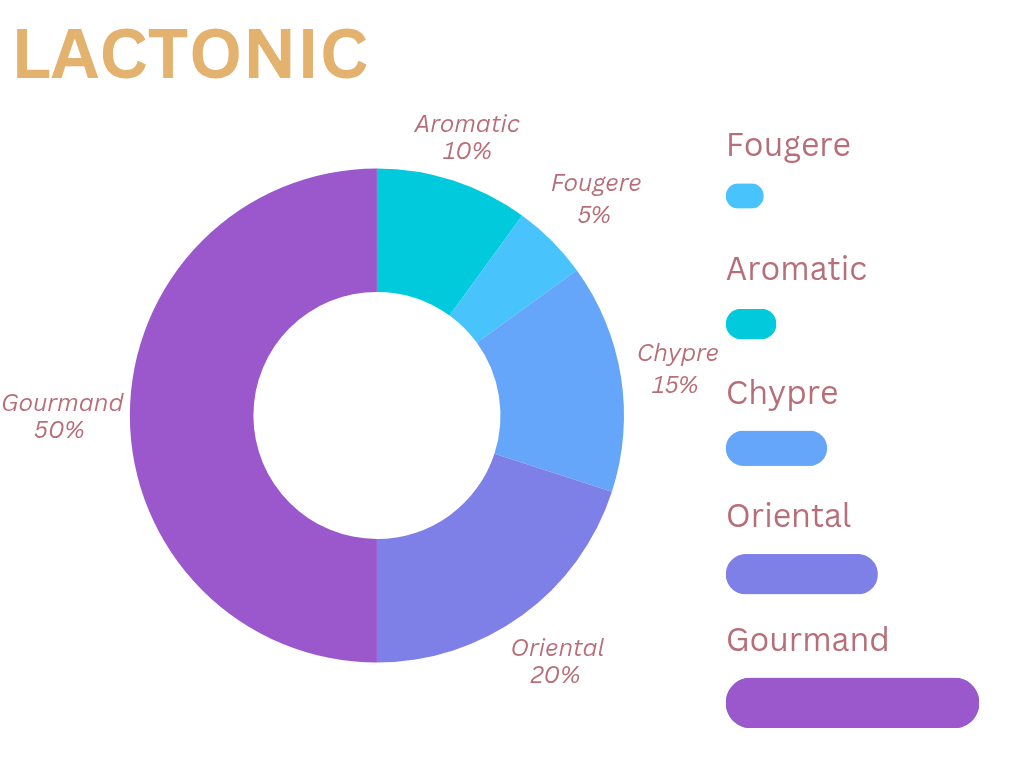
4. Boozy Accord
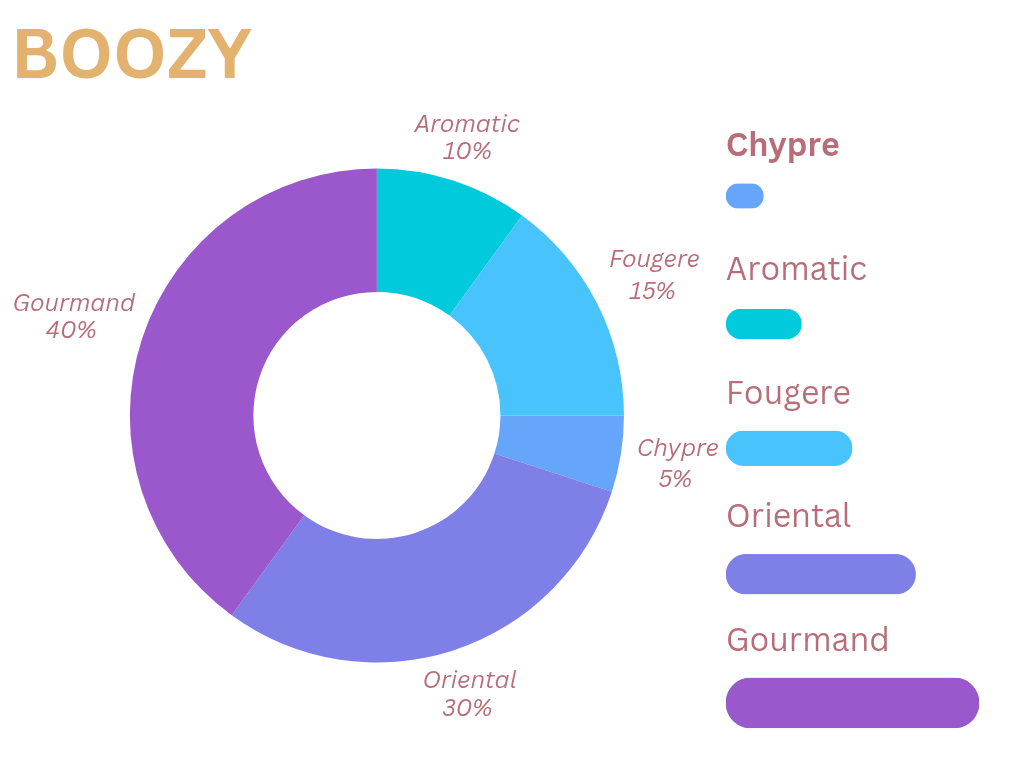
Oriental Acoords
1. Ambery Accord
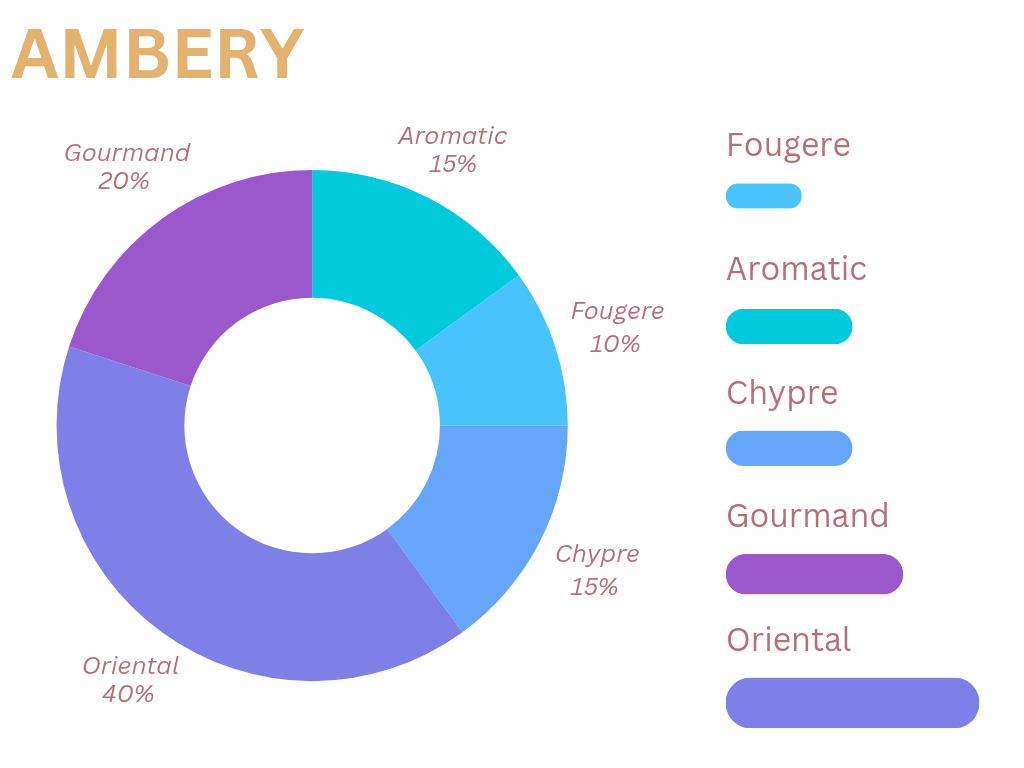
2. Balsamic Accord
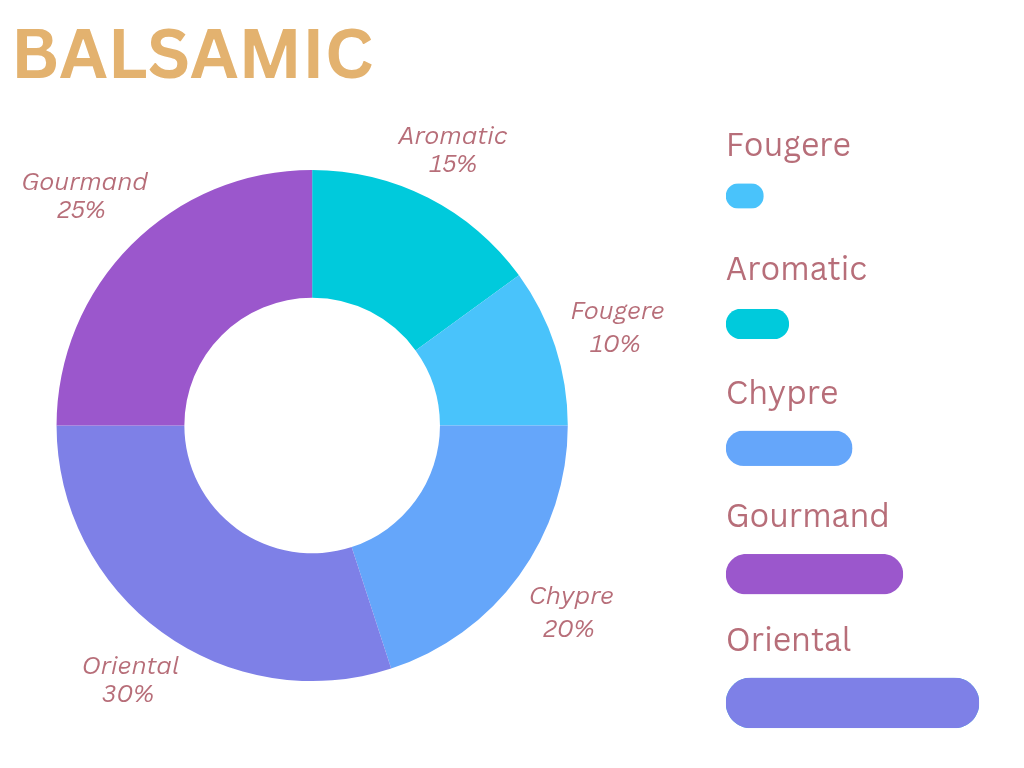
3. Incense Accord
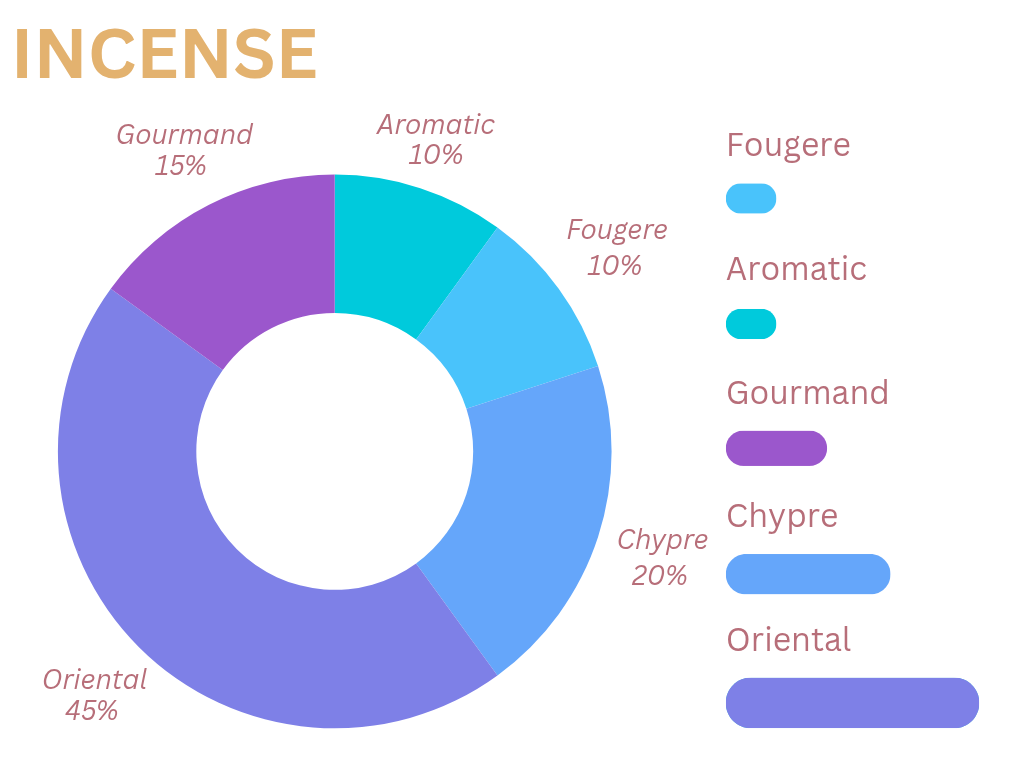
4. Earthy Accord
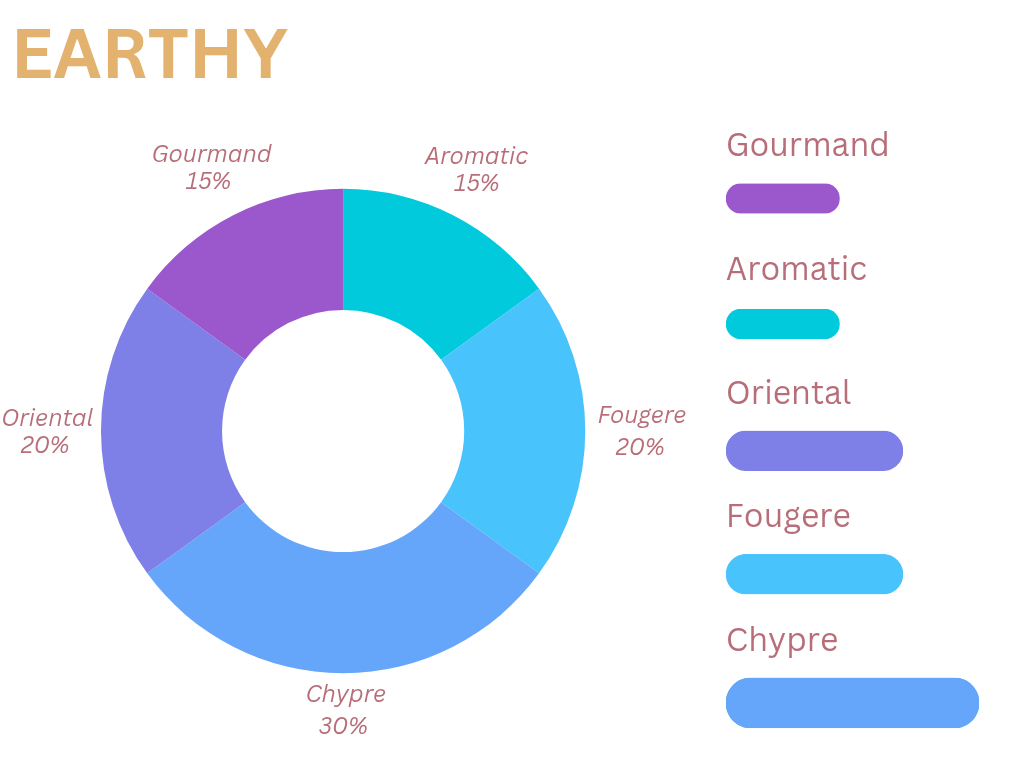
Fresh Accords
1. Aquatic Accord
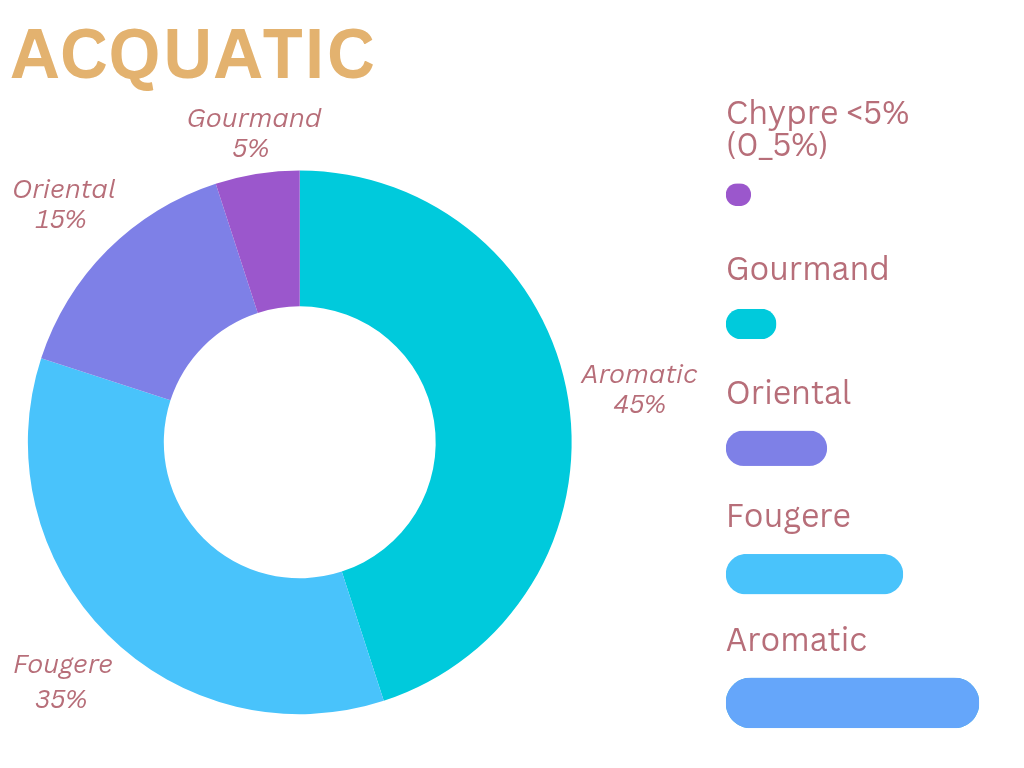
2. Marine Accord
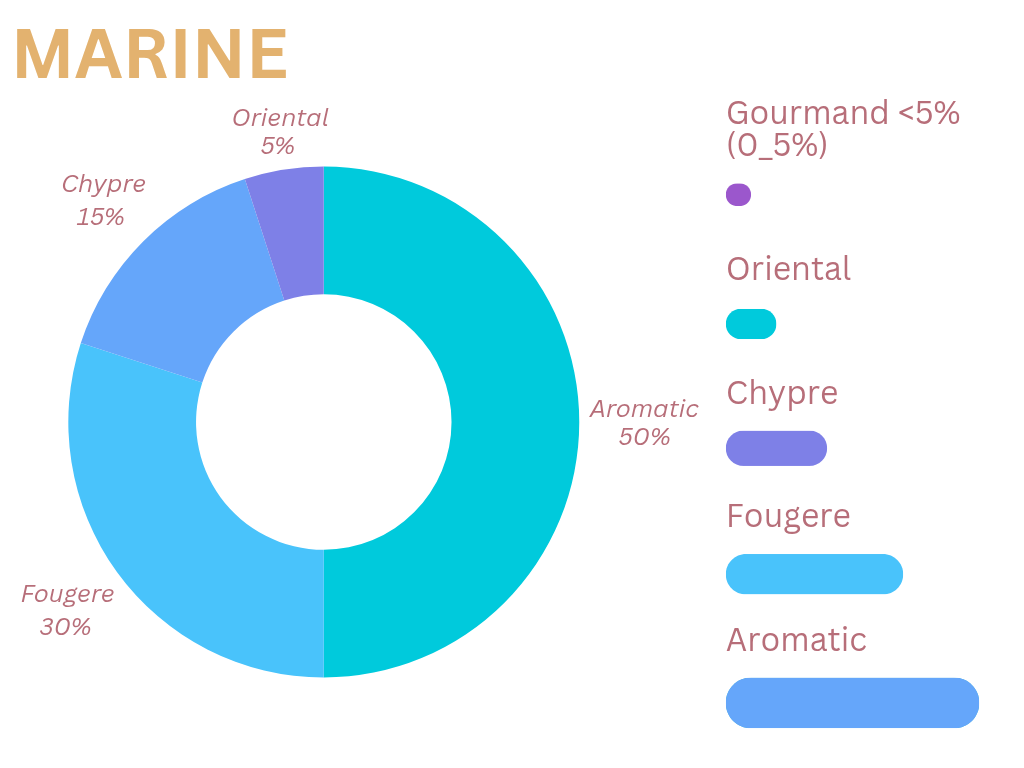
3. Mineral Accord