


Smell is the least understood of our senses, partly because the sense of smell is a subjective phenomenon that cannot be studied with ease in lower animals.
The sense of smell is much better developed in some animals e.g pigs, bears, and dogs than in humans. The ability of dogs to track other animals on the basis of odor is legendary, as is the use of pheromones by insects to attract mates. However, olfaction contributes to humans’ emotional life, and odors can effectively conjure up memories. It also helps people avoid consuming spoiled food and detect dangerous situations.
Smell is also known as olfaction. The receptors are classified as chemoreceptors because they respond to airborne chemicals that dissolve in fluids of the nasal mucosa.
As many as 1000 different odor receptors are coded in the human genome, and although only approximately 350 types are functional, they represent the largest population of G protein coupled receptors in the genome.
More than 20,000 odors are thought to be detected by odor-receptor proteins enriched in the ciliary membranes.
Olfactory neurons degenerate with a lifetime (turnover) of 30–40 days. The dying neuron is replaced by a newly differentiated stem cell, which eventually expresses the same cellular properties in terms of odor sensitivity, odor preference, and axonal projection as the previous neuron.
Women typically outperform men on tests of olfactory function and retain normal smell function to a later age than do men.
It is apparent that significant decrements in the ability to smell are present in >50% of
the population between 65 and 80 years of age and in 75% of those aged ≥80 years.
Odors are detected by olfactory chemoreceptor cells, which are continuously regenerated in the olfactory mucosa. These cells are true neurons that are endowed with a wide array of G protein–coupled receptors that enable the detection of hundreds of odor molecules.
Humans have about 10 million olfactory chemoreceptors. Like taste cells, olfactory chemoreceptors have a short life span (roughly, 60 days), and they are also continuously replaced. However, olfactory receptor cells are true neurons and, as such, are one of two neuron types that are continuously regenerated throughout life (granule cells of the hippocampal dentate gyrus are the other neuron type). The olfactory mucosa is exposed to odorant molecules by ventilatory air currents or from the oral cavity during feeding. Sniffing increases the influx of odorants. The odorants are temporarily bound in mucus to an olfactory binding protein that is secreted by a gland in the nasal cavity. Olfactory coding resembles taste coding in that most natural odors are complex and consist of many molecules that excite a wide variety of olfactory chemoreceptors. Coding for a particular perceived odor depends on the responses of many olfactory chemoreceptors, and the strength of the odorant is represented by the overall amount of afferent neural activity.
Odor Detection Threshold
Odorants are generally small, containing between 3 and 20 carbon atoms; molecules with the same number of carbon atoms but different structural configurations have different odors. Relatively high water and lipid solubility is characteristic of substances with strong odors.
The odor detection threshold is the lowest concentration of a chemical that can be detected. Examples of substances detected at very low concentrations include hydrogen sulfide (0.0005 parts per million, ppm), acetic acid (0.016 ppm), kerosene (0.1 ppm), and gasoline (0.3 ppm). Some toxic substances are essentially odorless; they have odor detection thresholds higher than lethal concentrations. For example, carbon dioxide is detected at 74,000 ppm but is lethal at 50,000 ppm. The odor detection threshold for a given odorant is not the same in all individuals.
The sense of smell is said to be more acute in women than in men, and in women it is most acute at the time of ovulation. Although olfactory discrimination is remarkable, determination of differences in the intensity of any given odor is poor. The concentration of an odor producing substance must be changed by about 30% before a difference can be detected. The comparable visual discrimination threshold is a 1% change in light intensity.
One of the most remarkable features of olfaction is the very high sensitivity or the low threshold of detection. Certain odors in the air are already detected, although not identified (“I smell something”), at a concentration as low as 4 × 10–15 g/l and are readily identified at 2 × 10–13 g/l. By comparison, one of the most potent taste molecules, quinine, is not detectable in water below 4 mg/l, whereas table salt is not detected in water below 1 g/l even by the finest palate. However, the olfactory system is subject to a rapid habituation that takes place within 1 min by the desensitization of the odor receptors at the periphery, and to a slower adaptation, starting usually after 1 min, of neuronal pathways in the central nervous system. Therefore, the olfactory system is always ready for the detection of novel odor molecules, but once they have been recognized, adaptation takes place and the odor signal is no longer perceived in a conscious manner.
Olfactory Membrane
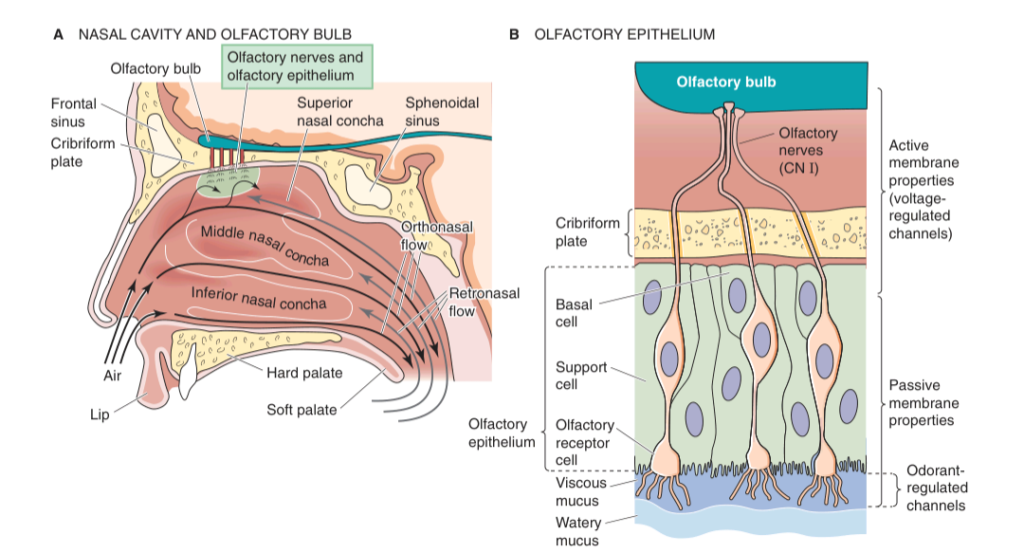
The olfactory membrane lies in the superior part of the nasal cavity. Medially, the olfactory membrane folds downward along the surface of the superior septum; laterally, it folds over the superior turbinate and even over a small portion of the upper surface of the middle turbinate. The olfactory membrane has a total surface area of about 5 square
centimeters in humans.
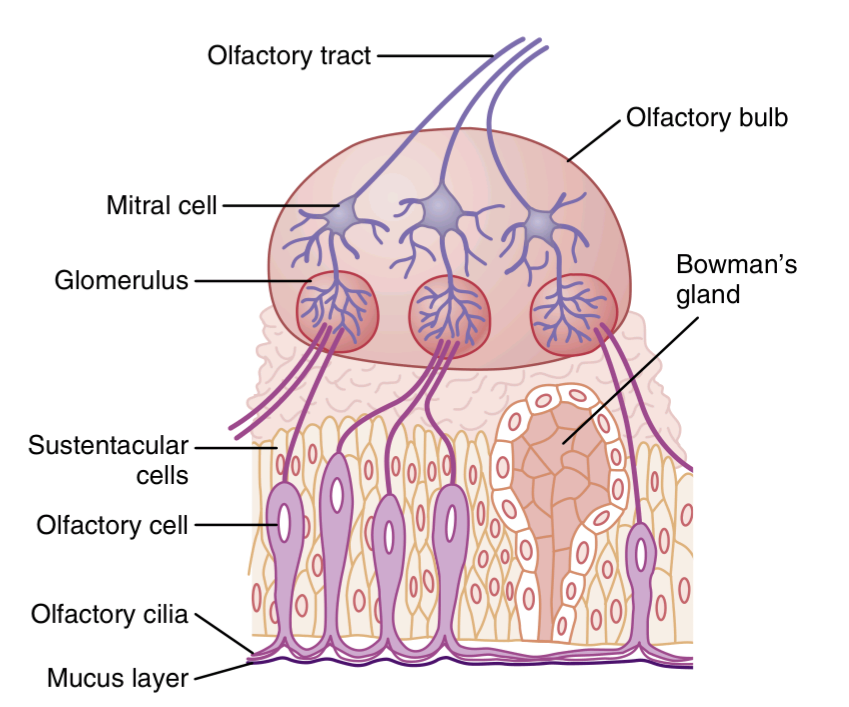
Olfactory Cells (The olfactory chemoreceptor cells) Are the Receptor Cells for Smell Sensation. The olfactory cells are actually bipolar nerve cells derived originally from the central nervous system and located in the olfactory mucosa. There are about 100 million of these cells in the olfactory epithelium interspersed among sustentacular cells.
The mucosal end of the olfactory cell forms a knob from which 4 to 25 olfactory hairs (also called olfactory cilia contain chemoreceptors that detect odorant chemicals dissolved in the overlying mucus layer), measuring 0.3 micrometer in diameter and up to 200 micrometers in
length, project into the mucus that coats the inner surface of the nasal cavity. These projecting olfactory cilia form a dense mat in the mucus, and it is these cilia that react to odors in the air and stimulate the olfactory cells, as discussed later. Spaced among the olfactory cells in the olfactory membrane are many small Bowman glands that secrete mucus onto the surface of the olfactory membrane.
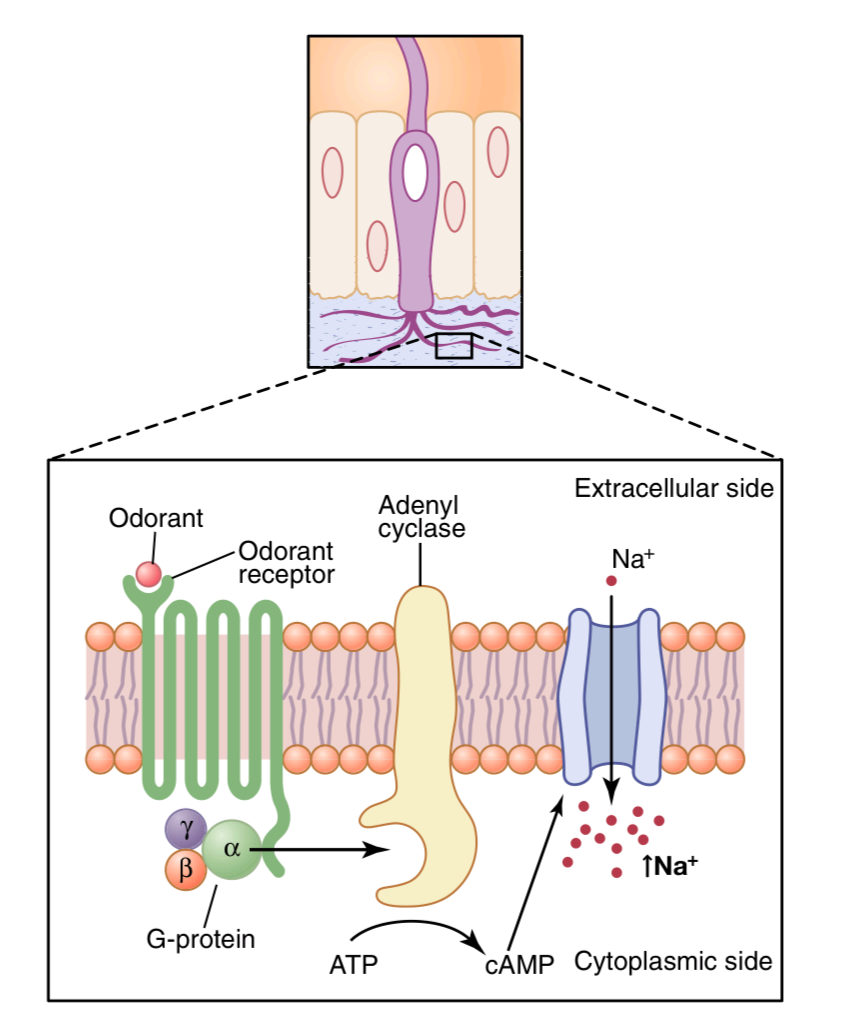
Excitation Of The Olfactory Cells
The portion of each olfactory cell that responds to the olfactory chemical stimuli is the olfactory cilia. The odorant substance, on coming in contact with the olfactory membrane surface, frst diffuses into the mucus that covers the cilia and then it binds with receptor proteins in the membrane of each cilium. Each receptor protein is actually a long molecule that threads its way through the membrane about seven times, folding inward and outward.
The odorant binds with the portion of the receptor protein that folds to the outside. The inside of the folding protein is coupled to a G protein, itself a combination of three subunits. On excitation of the receptor protein, an alpha subunit breaks away from the G protein and activates adenylyl cyclase, which is attached to the inside of the ciliary membrane near the receptor cell body. Te activated cyclase, in turn, converts many molecules of intracellular adenosine triphosphate (ATP) into cyclic adenosine monophosphate (cAMP). Finally, this cAMP activates another nearby membrane protein, a gated sodium ion channel, that opens its “gate” and allows large numbers of sodium ions to pour through the membrane into the receptor cell cytoplasm. The sodium ions increase the electrical potential in the positive direction inside the cell membrane, thus exciting the olfactory neuron and transmitting action potentials into the central nervous system via the olfactory nerve.
The importance of this mechanism for activating olfactory nerves is that it greatly multiplies the excitatory effect of even the weakest odorant. To summarize:
(1) activation of the receptor protein by the odorant substance activates the G-protein complex, which, in turn (2) activates multiple molecules of adenylyl cyclase inside the olfactory cell membrane, which (3) causes the formation of many times more molecules of cAMP, and fnally, (4) the cAMP opens still many times more sodium ion channels. Terefore, even a minute concentration of a specifc odorant initiates a cascading effect that opens extremely large numbers of sodium channels. This process accounts for the exquisite sensitivity of the olfactory neurons to even the slightest amount of odorant. In addition to the basic chemical mechanism whereby the olfactory cells are stimulated, several physical factors affect the degree of stimulation. First, only volatile substances that can be sniffed into the nasal cavity can be smelled. Second, the stimulating substance must be at least slightly water-soluble so that it can pass through the mucus to reach the olfactory cilia. Third, it is helpful for the substance to be at least slightly lipid-soluble, presumably because lipid constituents of the cilium are a weak barrier to non–lipid-soluble odorants.
FAST FACT
The senses of smell and taste are closely related. In fact, people who lose their sense of smell typically complain that food has lost much of its taste.
Membrane Potentials and Action Potentials in
Olfactory Cells
The membrane potential inside unstimulated olfactory cells, as measured by microelectrodes, averages about -55 millivolts. At this potential, most of the cells generate continuous action potentials at a very slow rate, varying from once every 20 seconds up to two or three per second. Most odorants cause depolarization of the olfactory cell membrane, decreasing the negative potential in the cell from the normal level of -55 millivolts to -30 millivolts or less. Along with this, the number of action potentials increases to 20 to 30 per second, which is a high rate for the minute olfactory nerve fbers. Over a wide range, the rate of olfactory nerve impulses changes approximately in proportion to the logarithm of the stimulus strength, which demonstrates that the olfactory receptors obey principles of transduction similar to those of other sensory receptors.
Transmission Of Smell Signals Into The Central Nervous System
The olfactory portions of the brain were among the frst brain structures developed in primitive animals, and much of the remainder of the brain developed around these olfactory beginnings. In fact, part of the brain that originally subserved olfaction later evolved into the basal brain structures that control emotions and other aspects of human behavior.
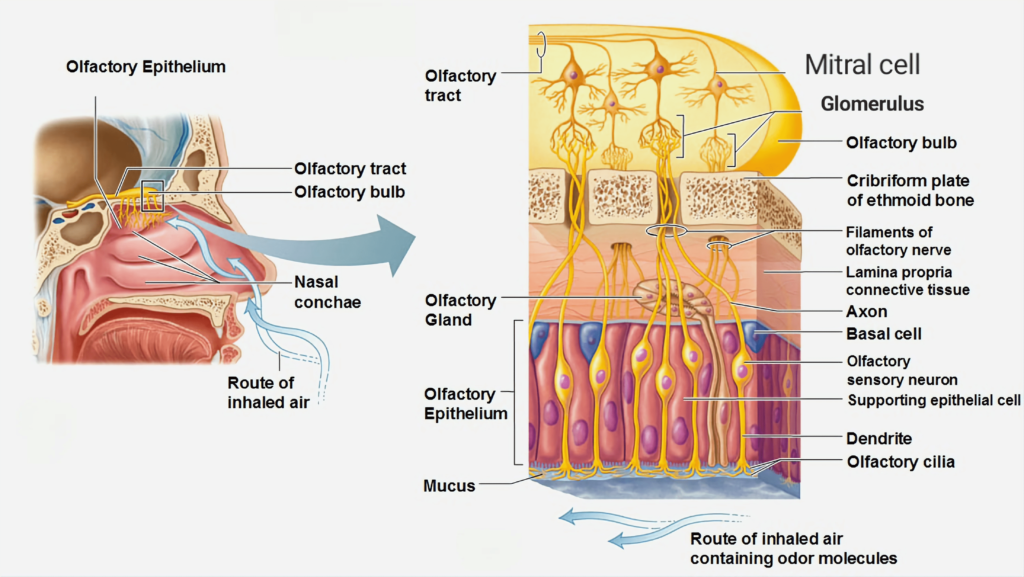
Our nasal cavity is lined with mucous membrane and you could see the olfactory bulb is just behind the cribriform plate.
The olfactory gland secretes mucus for dissolving odor molecules.
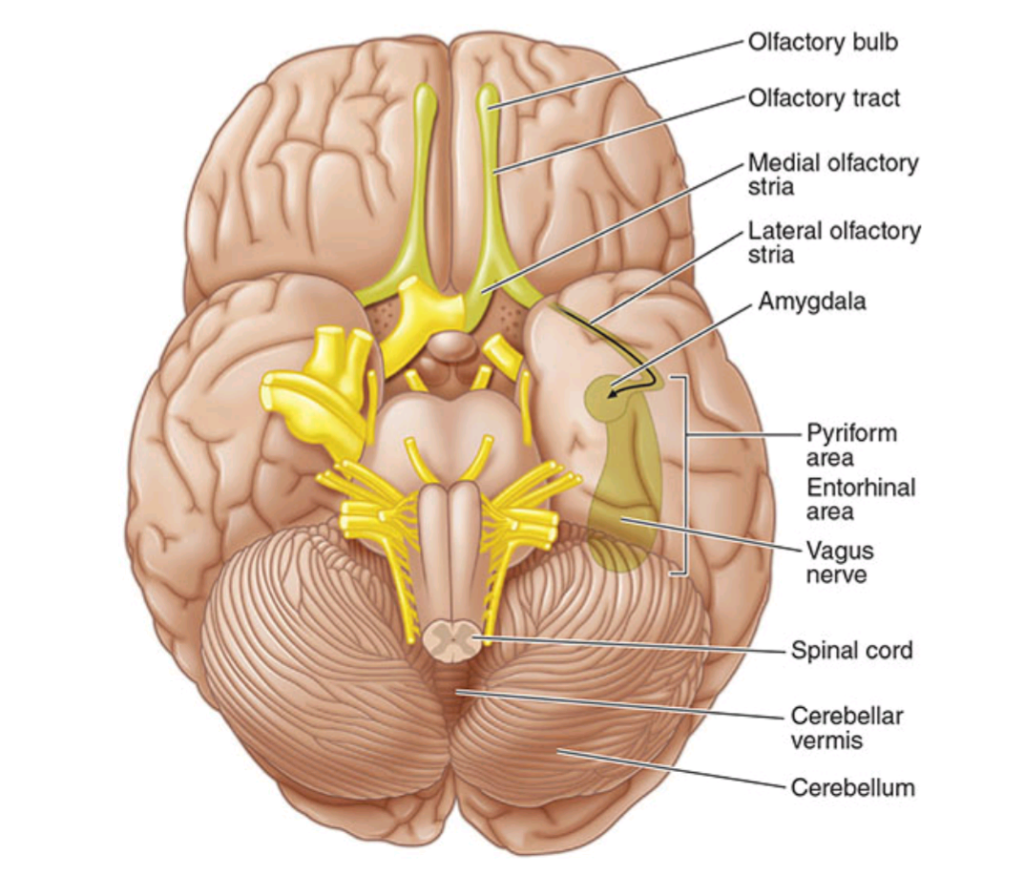
Transmission of Olfactory Signals Into the Olfactory Bulb. The olfactory nerve fbers leading backward from the bulb are called cranial nerve I, or the olfactory tract. In reality, both the tract and the bulb are an anterior outgrowth of brain tissue from the base of the brain; the bulbous enlargement at its end, the olfactory bulb, lies over the cribriform plate of the ethmoid bone, separating the brain cavity from the upper reaches of the nasal cavity. The cribriform plate has multiple small perforations through which an equal number of small nerves pass upward from the olfactory membrane in the nasal cavity to enter the olfactory bulb in the cranial cavity.
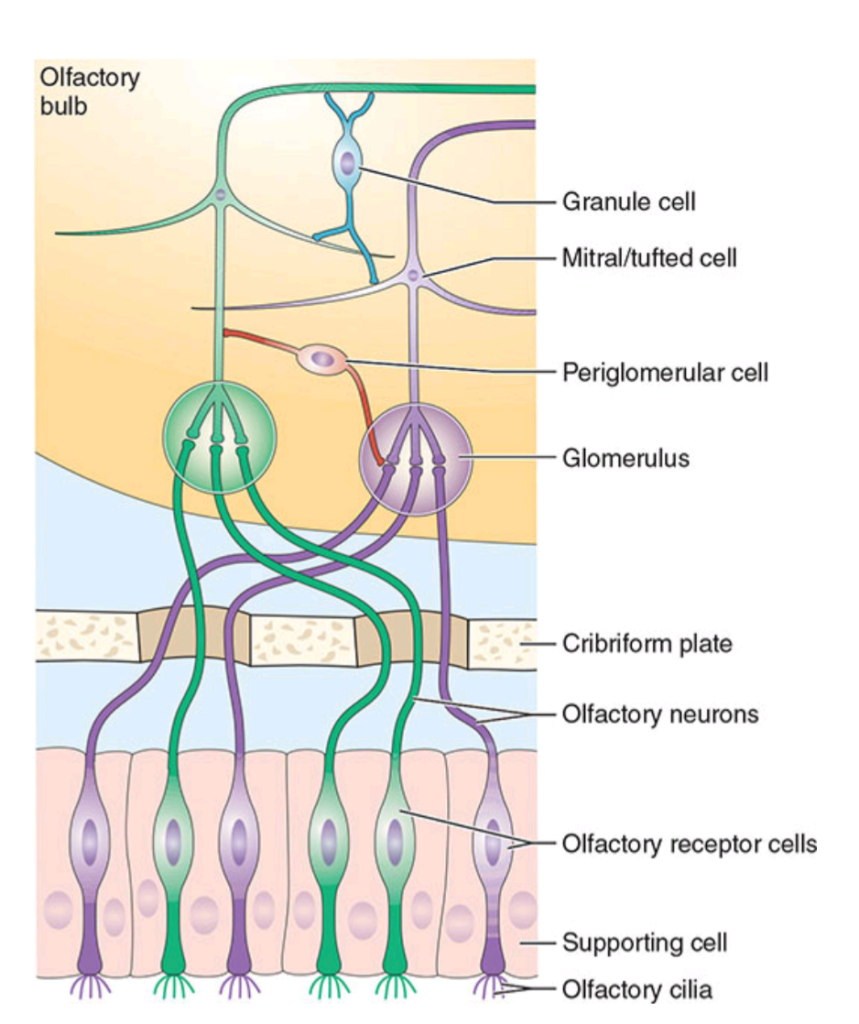
Short axons from the olfactory cells terminating in multiple globular structures in the olfactory bulb called glomeruli. Each bulb has several thousand such glomeruli (specific for each stimulus type), each of which is the terminus for about 25,000 axons from olfactory cells. Each glomerulus also is the terminus for dendrites from about 25 large mitral cells and about 60 smaller tufted cells, the cell bodies of which lie in the olfactory bulb superior to the glomeruli. These dendrites receive synapses from the olfactory cell neurons; the mitral and tufted cells send axons through the olfactory tract to transmit olfactory signals to higher levels in the central nervous system. Some research has suggested that different glomeruli respond to different odors. It is possible that specifc glomeruli are the real clue to the analysis of different odor signals transmitted into the central nervous system.
FAST FACT
Olfactory receptors are quickly fatigued; they will stop sensing even the strongest smells after a short time.
Primitive and Newer Olfactory Pathways Into the Central Nervous System
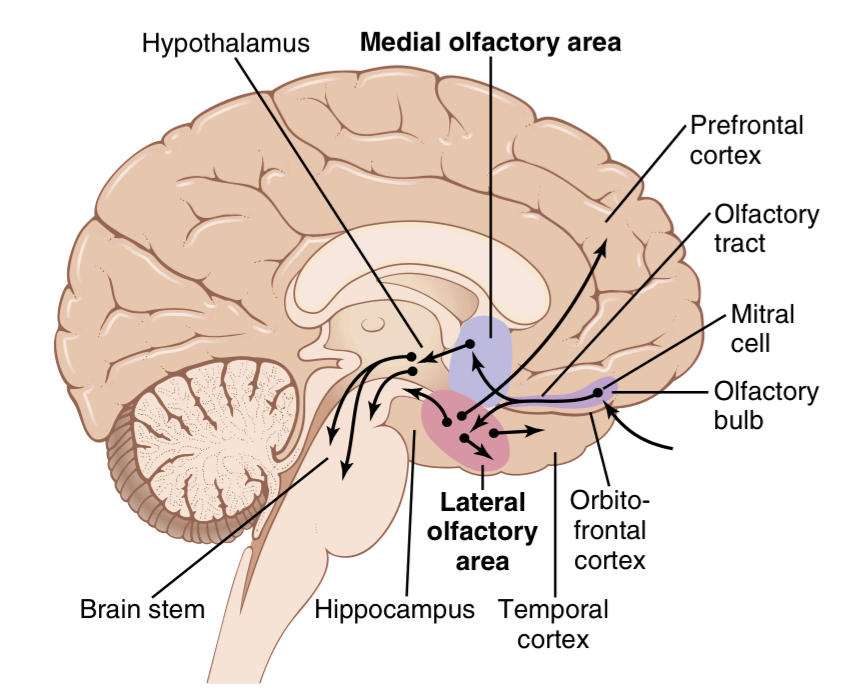
The olfactory tract enters the brain at the anterior junction between the mesencephalon and cerebrum; there, the tract divides into two pathways, one passing medially into the medial olfactory area of the brain stem and the other passing laterally into the lateral olfactory area. The medial olfactory area represents a very primitive olfactory system, whereas the lateral olfactory area is the input to the following: (1) a less old olfactory system; and (2) a newer system.
The Primitive Olfactory System _ The Medial Olfactory
Area. The medial olfactory area consists of a group of nuclei located in the midbasal portions of the brain immediately anterior to the hypothalamus. Most conspicuous are the septal nuclei, which are midline nuclei that feed into the hypothalamus and other primitive portions of the brain’s limbic system. This is the brain area most concerned with basic behavior. The importance of this medial olfactory area is best understood by considering what happens in animals when the lateral olfactory areas on both sides of the brain are removed, and only the medial system remains. The removal of these areas hardly affects the more basic responses to olfaction, such as licking the lips, salivation, and other feeding responses caused by the smell of food or by basic emotional drives associated with smell. Conversely, removal of the lateral areas abolishes the more complicated olfactory conditioned reflexes.
The Less Old Olfactory System _ The Lateral Olfactory
Area. The lateral olfactory area is composed mainly of the prepyriform and pyriform cortex plus the cortical portion of the amygdaloid nuclei. From these areas, signal pathways pass into almost all portions of the limbic system, especially into less primitive portions such as the hippocampus, which seem to be most important for learning to like or dislike certain foods depending on one’s experiences with them. For example, it is believed that this lateral olfactory area and its many connections with the limbic behavioral system cause a person to develop an absolute aversion to foods that have caused nausea and vomiting. An important feature of the lateral olfactory area is that many signal pathways from this area also feed directly into an older part of the cerebral cortex called the paleocortex in the anteromedial portion of the temporal lobe. Tis area is the only area of the entire cerebral cortex where sensory signals pass directly to the cortex without passing frst through the thalamus.
The Newer Pathway. A newer olfactory pathway that passes through the thalamus, passing to the dorsomedial thalamic nucleus and then to the lateroposterior quadrant of the orbitofrontale cortex, has been found. On the basis of studies in monkeys, this newer system probably helps in the conscious analysis of odor.
Thus, there appear to be a primitive olfactory system that subserves the basic olfactory reflexes, a less old system that provides automatic but partially learned control of food intake and aversion to toxic and unhealthy foods, and a newer system that is comparable to most of the other cortical sensory systems and is used for conscious perception and analysis of olfaction.
After a stimulus reaches the primary olfactory cortex, it may continue on to a number of other locations in the cerebrum and brainstem _ including the hippocampus and amygdala (The amygdala is specialized for input and processing of emotion, while the hippocampus is essential for declarative or episodic memory). This explains why certain odors can evoke a memory, an emotional response.
And still sense of smell to be one of the most mysterious out of our five senses.