

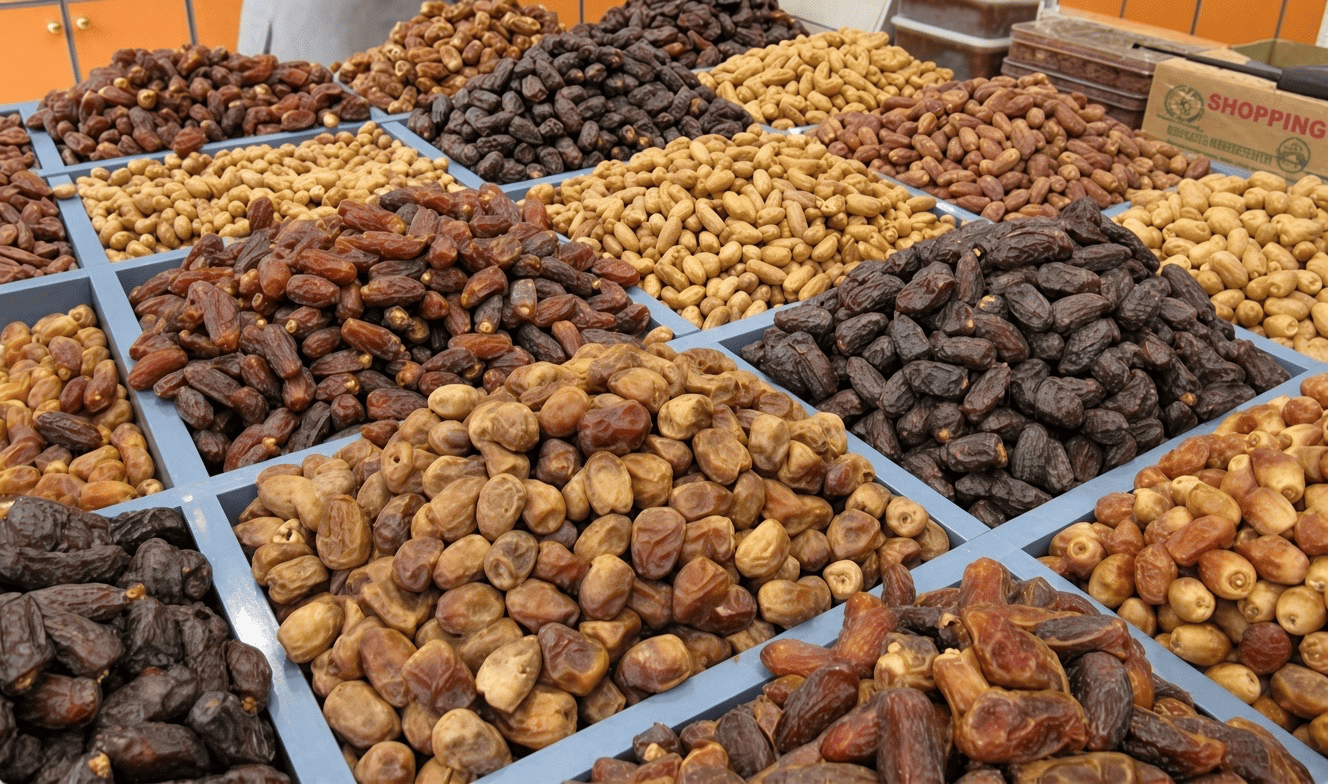
Dates in Saudi Arabia are not merely a measure of hospitality or a customary part of everyday life among Saudis. They have a deep-rooted connection to the country’s history, serving as a symbol of authentic identity and culture, and as a lifeline from which fathers and ancestors drew patience and strength in the heart of the desert. Today, dates have become a historic legacy and an important economic resource, embodying the richness of the past while opening the way toward the possibilities of the future.
Dates are among the most important agricultural and food crops in the Kingdom of Saudi Arabia, and they are deeply intertwined with Saudi culinary and social heritage. The Kingdom is home to an extraordinary diversity of date palm varieties, resulting in a broad spectrum of flavors, aromas, textures, colors, and levels of sweetness.
The taste of Saudi dates cannot be described through a single profile. Some varieties possess an exceptionally pronounced sweetness, while others offer a more balanced and restrained sweetness. Certain varieties reveal nuances reminiscent of honey, caramel, or toffee, while others develop deeper flavors that can evoke date syrup, dried fruits, roasted coffee, raisins, and plums.
The same variety can also change noticeably according to its stage of ripeness: Khalal, Rutab, and Tamar. Agricultural references confirm that the preferred stage of ripeness varies according to the variety and consumer preference.
Each region and city of the Kingdom is associated with distinctive date varieties, each possessing its own character. For example:
🌴 Sukkari (Al-Qassim): Exceptionally high sweetness with a soft to firm texture, accompanied by aromatic notes reminiscent of honey, caramel, toffee, and burnt sugar.
🌴 Khalas (Al-Ahsa and Al-Qassim): High yet well-balanced sweetness with a rich texture, a warm honeyed aroma, and a concentrated flavor that becomes juicier during the Rutab stage.
🌴 Ajwa (Medina): Less intense sweetness with a fleshy texture and a deep character leaning toward dried fruits, complemented by subtle earthy or woody nuances.
🌴 Safawi (Medina): Balanced sweetness and a firm, fleshy texture, with warm date-like flavors and nuances reminiscent of plum and dried fruits.
🌴 Khudri: Moderate to high sweetness with a firm texture and a pronounced date character, making it suitable both for direct consumption and processing.
🌴 Nabtat Ali: High sweetness and a fleshy texture, with a concentrated date flavor accompanied by fruity and caramel-like nuances.
🌴 Mabroom (Medina): Balanced sweetness with a deep character and firm texture, revealing notes of date syrup and dried fruits.
From an olfactory perspective, these aromas can be summarized through what could be described as an “olfactory pyramid,” in which the aromatic character unfolds through primary impressions such as honey and sugar, secondary facets such as caramel, toffee, and dried fruits, and deeper nuances that can become woody, earthy, and roasted.
Saudi dates therefore possess a distinctive aromatic profile combining sugary, caramelized, woody, earthy, and roasted facets. These characteristics are influenced by the nature of the land, soil, and climatic conditions in which the date palms are cultivated. Humidity also plays a significant role in shaping many of these characteristics, while cultivation and storage conditions have a major impact on texture, flavor concentration, and the final quality of the fruit.
Ultimately, the diversity of Saudi dates is not merely a matter of taste; it is an olfactory expression of the land itself—a meeting point between climate, soil, cultivation, heritage, and time.